


Have you ever stopped mid-sentence, unsure whether to add an extra “e” to a word you use all the time? Many writers face this problem with judgmental or judgemental, especially when a spell checker underlines one version but accepts the other. It is a fair worry, because both spellings appear in books, news articles, and social media posts.
The short answer is that both are accepted, but the right choice depends on your audience. This article explains the meaning of each word, where the spelling difference comes from, and how American and British English treat them. You will also find simple examples, common mistakes, and quick tips so you can choose the correct spelling with confidence every time you write.
Judgmental
Judgmental is the standard American spelling. It has no “e” between the “g” and the “m”, which matches the American spelling of judgment.
You will see this form in U.S. dictionaries, newspapers, and style guides.
Judgemental
Judgemental is the common British spelling. It keeps the “e” from the base word judge, which gives you judgement and judgemental.
This form is widely used in the UK, Australia, and other places that follow British conventions.
| Related Articles You’ll Love |
| 125+ Powerful Alternatives to “The Author States” (With Examples) |
| Analysing or Analyzing? Get the Spelling Right |
| Followup or Follow Up? Get It Right Every Time |
Judgmental or Judgemental Oxford Dictionary
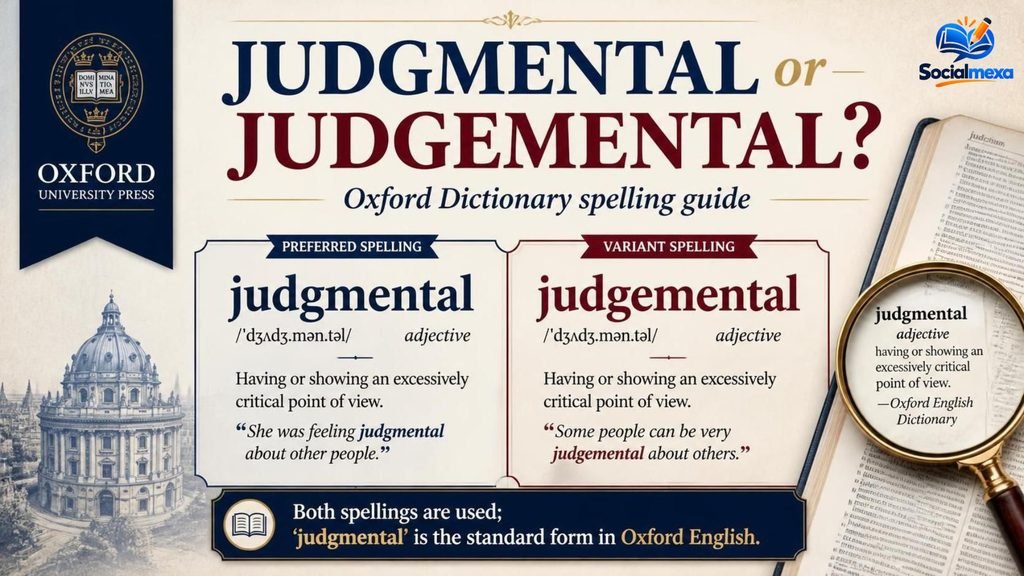
Major dictionaries, including Oxford, list both spellings as acceptable. They treat one as the main form for a region and the other as a variant.
This means neither spelling is a mistake. The only real error is switching between them in the same piece of writing.
Judgemental Opposite
The opposite of judgmental is nonjudgmental, which describes someone who accepts others without criticizing them. Other opposites include open-minded, tolerant, accepting, and understanding.
In British English, the same word is written non-judgemental or nonjudgemental. The “e” follows the same regional rule.
Judgmental or Judgemental: Quick Answer
Use judgmental for American audiences and judgemental for British audiences. Both words mean the same thing, so the difference is only in spelling.
Examples:
- American: “She felt judgmental comments were unfair.”
- British: “She felt judgemental comments were unfair.”
Judgmental or Judgemental
The comparison of judgemental vs judgmental comes down to one letter. The meaning, pronunciation, and grammar stay the same.
Both words are adjectives, and both are pronounced the same way. If you can say one, you can say the other.
Judgmental or Judgemental Meaning
The judgmental meaning is simple: it describes a person, tone, or remark that is overly critical of others. A judgmental person tends to form opinions quickly, often without knowing the full story.
The word can also be neutral in rare cases, where it only refers to the act of judging. For example, a “judgmental error” is a mistake in decision making. Most of the time, though, the word carries a negative feeling.
The Origin of Judgmental or Judgemental
Both words come from the verb judge, which came into English from Old French jugier. That French word traces back to the Latin iudicare, meaning “to give a verdict.”
English added the ending “-ment” to make judgment, then “-al” to make judgmental. Whether the “e” stays after “g” is what separates the two versions.
British English vs American English Spelling

Spelling differences between the UK and the US are common. American English often simplifies words, while British English tends to keep more of the original form.
Key Difference:
American English usually drops the silent “e” before the suffix “-ment”. British English often keeps it.
Comparison Table
| Word | American English | British English |
| Adjective | judgmental | judgemental |
| Noun | judgment | judgement |
| Adverb | judgmentally | judgementally |
| Opposite | nonjudgmental | non-judgemental |
Examples:
- American: “Try not to be so judgmental.”
- British: “Try not to be so judgemental.”
- Similar pair: acknowledgment (US) and acknowledgement (UK).
Judgmental or Judgemental Synonym
A judgmental synonym helps you avoid repeating the same word. Useful options include critical, disapproving, fault-finding, harsh, and condemnatory.
Choose the synonym that fits your tone. “Critical” is mild, while “condemnatory” sounds much stronger.
Which Spelling Should You Use?
Your best choice depends on who will read your writing. Think about location first, then about any style guide you must follow.
Use “Judgmental” when:
- Your readers are mainly in the United States or Canada.
- You follow an American style guide.
Use “Judgemental” when:
- Your readers are mainly in the UK, Australia, or New Zealand.
- You follow a British style guide.
For Global Use:
If your audience is mixed, pick one spelling and stay consistent. Many international writers choose the American form because it is shorter.
Pro Tip:
Set your word processor to the correct language, such as English (US) or English (UK). The spell checker will then flag the wrong version for you.
How to Spell Judgmental
To learn how to spell judgmental, remember the pattern: J-U-D-G-M-E-N-T-A-L. There is no “e” after the “g”.
A helpful trick is to think of “judgment” as a word without any extra letters. Then add “-al” to the end.
Common Mistakes with Judgmental or Judgemental
Mistake 1:
Mixing both spellings in one article. Pick one and use it everywhere.
Mistake 2:
Using the British spelling for an American audience, or the reverse. Always match the spelling to the reader.
Mistake 3:
Adding extra letters, such as “judgementle” or “judgmentel”. The word ends in “-al”.
Mistake 4:
Thinking one version is wrong. Both are correct in the right setting.
Judgmental or Judgemental Examples
Examples make the difference easier to see. Here are a few sentences in both styles.
- American: “I don’t want to sound judgmental, but that plan seems risky.”
- British: “I don’t want to sound judgemental, but that plan seems risky.”
- American: “He answered the question judgmentally.”
- British: “He answered the question judgementally.”
Critical and Judgemental
The phrase “critical and judgemental” is common because the two words are close in meaning. Being critical can be helpful when you give useful feedback. Being judgemental usually means criticizing without understanding.
A good rule is that criticism focuses on an action, while a judgmental attitude focuses on the person.
Is Judgemental a Word
Yes, judgemental is a real word. It is the accepted British spelling and appears in many UK dictionaries.
Some American spell checkers may underline it, but that does not make it wrong. It only means the software is set to US English.
Judgmental or Judgemental in Everyday Examples
In Daily Conversation:
“Please don’t be judgmental about my choices.” Spoken English does not show the spelling, so the word sounds the same in both regions.
In Emails:
“Thanks for the honest feedback. I’ll try to stay nonjudgmental in the next meeting.” Match the spelling to your reader’s country.
In Social Media:
“Why are people so judgemental online?” Casual posts often use the spelling that matches the writer’s location.
In Formal Writing:
“The report avoids a judgmental tone and focuses on facts.” In formal work, follow the required style guide.
How to Spell Judgemental
The correct way to spell judgemental is J-U-D-G-E-M-E-N-T-A-L. Keep the “e” after the “g” and end with “-al”.
It helps to remember that British English keeps the “e” from judge. Say “judge” first, then add “-mental” in your head.
Judgmental Person
A judgmental person is someone who quickly criticizes others based on appearance, choices, or beliefs. A judgmental attitude often comes from assumptions rather than facts.
Signs of this behavior include judgmental comments, a harsh judgmental tone, and a habit of labeling people. The healthier alternative is curiosity, which means asking questions before forming an opinion.
Judgmental or Judgemental: Google Trends & Usage Data
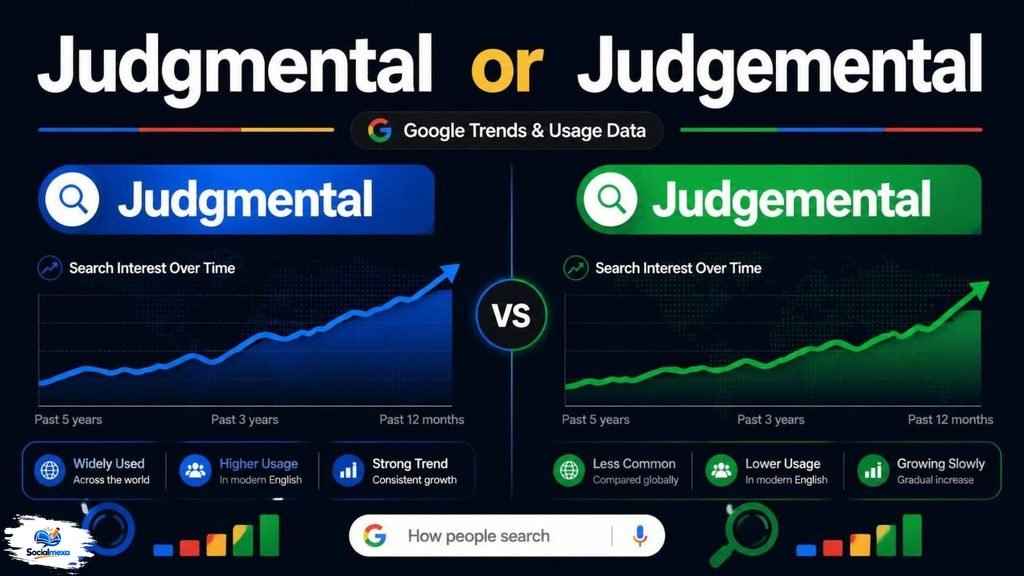
Search and usage patterns generally follow location. Writers in the US lean toward judgmental, while writers in the UK, Australia, and several other countries lean toward judgemental.
Usage Insight:
Because both spellings are searched often, readers clearly want a quick answer. Check current trend data for your own region before you decide, since numbers change over time.
Comparison Table: Judgmental or Judgemental
| Feature | Judgmental | Judgemental |
| Region | United States | United Kingdom |
| Meaning | Overly critical | Overly critical |
| Pronunciation | Same | Same |
| Related noun | judgment | judgement |
| Correct? | Yes | Yes |
FAQs
Which is correct, Judgmental or Judgemental?
Both are correct. Judgmental is standard in American English, and judgemental is standard in British English.
Why do we drop the e in judgment?
American English simplified many words by removing a silent “e” before “-ment”. British English kept it.
What is a judgmental person?
A judgmental person criticizes others quickly, often without knowing the full situation. They tend to form negative opinions easily.
What’s the difference between judgment and judgmental?
Judgment is a noun meaning an opinion or decision. Judgmental is an adjective describing someone who is overly critical.
Conclusion
The choice between judgmental or judgemental is a matter of audience, not correctness. Judgmental is the American spelling, and judgemental is the British one. Both mean overly critical, and both follow the same pronunciation and grammar. The same rule applies to judgment and judgement.
For a clear takeaway, check who will read your writing and pick the matching spelling. Then stay consistent from the first line to the last. If you remember that the “e” is the only difference, you will never have to guess again.

Emily Carter is an English language writer who creates simple guides on grammar, word meanings, spelling, slang, and everyday English. Her goal is to make confusing language topics clear, practical, and easy to understand.
1 thought on “Judgmental or Judgemental? Discover the Correct Spelling”