


If you have ever paused mid sentence wondering whether to type “todays report” or “today’s report,” you are not alone. This tiny apostrophe trips up students, professionals, and even experienced writers every single day. The good news is that the rule behind it is short, simple, and easy to remember once it clicks.
In this guide, we will break down exactly when to use today’s versus todays, why the apostrophe matters so much, and how to avoid the small mistakes that make writing look careless. By the end, you will never second guess this word again.
Quick definition: “Today’s” is the possessive form of “today” and is used whenever something belongs to or is connected with the present day, such as today’s news or today’s weather. “Todays” without an apostrophe is not a standard word in modern English and should be avoided in nearly all writing.
Today’s or Todays – Quick Answer

Here is the short version if you only have ten seconds:
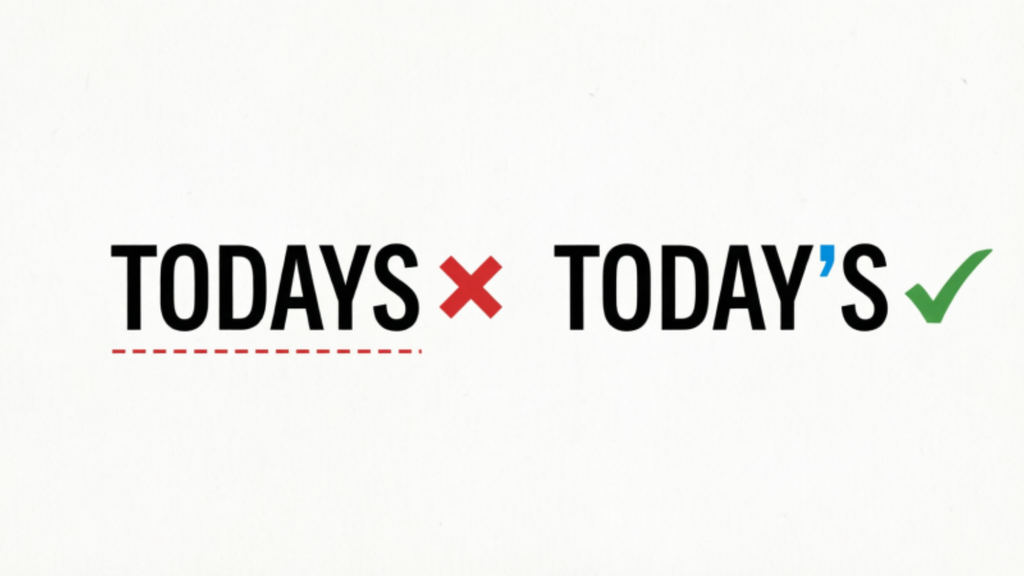
- Use today’s (with an apostrophe) whenever you are showing that something belongs to today, such as today’s meeting, today’s date, or today’s schedule.
- Avoid todays (no apostrophe) in almost every case. It is not considered correct in standard English writing, whether formal or casual.
If you remember nothing else from this article, remember that rule. Everything below simply explains why it works this way and how to apply it confidently in real sentences.
Read More Grammar To Visit
What Is “Today”?
Before diving into apostrophes, it helps to understand the word itself. “Today” refers to the current day, the one happening right now, as opposed to yesterday or tomorrow. It can function in a few different ways in a sentence:
- As a noun: Today is a beautiful day.
- As an adverb: I am meeting my friend today.
- As a possessive noun: Today’s weather is beautiful.
Because “today” is a singular noun when used this way, it follows the same possessive rules as any other singular noun in English, like “dog” becoming “dog’s” or “teacher” becoming “teacher’s.”
The Origin of Today’s or Todays
“Today” comes from Old English, formed by combining “to” and “dæg” (day), essentially meaning “on this day.” Over centuries, the two parts merged into the single word we use now.
Because “today” behaves as an ordinary singular noun in modern English, it takes the standard apostrophe-plus-s ending to show possession, just like thousands of other English nouns. This is why “today’s” follows the same familiar pattern as “the dog’s bone” or “the company’s policy.”
Today’s or Todays meaning

The meaning changes depending on which form you use, even though only one of them is actually correct in standard writing:
- Today’s means something belonging to, happening on, or connected with the present day. Today’s lunch means the lunch being served today.
- Todays would technically suggest multiple instances of “today,” which does not make logical sense since there is only one today at any given moment. This is part of why the word is considered nonstandard.
When people search for “todays meaning,” they are usually trying to confirm whether the apostrophe changes anything. It does. The apostrophe is what turns “today” into a word that shows ownership or connection.
British English vs. American English Spelling
Here is some good news: this is not one of those words where British and American English disagree. Both dialects follow the same apostrophe rule.
- ✅ Today’s is correct in both British and American English.
- ❌ Todays is incorrect in both British and American English.
Unlike words such as “colour” versus “color” or “organise” versus “organize,” there is no regional variation here. Whether you are writing for a US audience, a UK audience, or anywhere else in the English speaking world, the possessive form always takes the apostrophe.
Key Rule: When to Use Today’s or Todays
The rule really comes down to one simple test. Ask yourself: does something belong to, or is it connected with, the present day?
- If yes, use today’s followed by a noun (today’s homework, today’s forecast, today’s agenda).
- If you are simply using “today” as a time word without showing possession, no apostrophe is needed at all (I will call you today).
There is rarely a legitimate case for plain “todays” in everyday writing. Even in the rare literary sense where someone might try to describe repeated days, most style guides and dictionaries do not recognize it as standard usage, so it is best avoided.
Today’s or Todays examples

Seeing the rule in action makes it much easier to remember. Here are some natural, everyday examples:
- Today’s news covered the local election results.
- Have you checked today’s exchange rate yet?
- Today’s lesson focuses on fractions.
- I forgot to bring today’s paperwork to the office.
- Today’s forecast calls for rain in the afternoon.
Notice how in every example, “today’s” is directly followed by a noun that it owns or describes.
For todays video
If you are writing a caption or script, the correct phrasing is “for today’s video,” not “for todays video.” For example: “For today’s video, we are testing three budget kitchen gadgets.” The video belongs to today, so the apostrophe is required.
Today’s world or today’s world
Both instances should read “today’s world,” since the phrase refers to the world as it exists in the present day. A sentence like “Today’s world moves faster than ever” is grammatically correct and reads naturally in essays, articles, and everyday conversation.
Today’s or Todays class
This one depends on the sentence structure:
- “I have class today” uses “today” as an adverb, describing when the class happens. No apostrophe needed.
- “Today’s class covers grammar rules” uses “today’s” as a possessive, showing that the class belongs to today. Apostrophe required.
The difference lies in whether “today” is describing a time or actually owning the noun that follows it.
Today’s or today’s date
Yes, this heading looks repetitive on purpose, because it is one of the most searched versions of this question, and the answer never changes: it is always “today’s date,” never “todays date.” If you are asking for the current date, filling out a form, or writing a note, the possessive apostrophe is required every time.
Today’s or Todays activity

Just like the class example above, this depends on function:
- “We have an activity today” (today as an adverb of time).
- “Today’s activity is a group project” (today’s as a possessive modifying “activity”).
The One Rule You Need to Know
If you only take away a single tip from this entire article, let it be this: if you can rephrase the sentence using “of today” and it still makes sense, you need the apostrophe.
- “Today’s news” = “the news of today” ✅
- “Today’s meeting” = “the meeting of today” ✅
If that substitution works, add the apostrophe. If “today” is simply telling you when something happens rather than what it owns, leave it alone with no apostrophe at all.
Comparison Table: Today’s or Todays Meeting
| Phrase | Correct? | Why |
| Today’s meeting | ✅ Correct | Shows the meeting belongs to today |
| Todays meeting | ❌ Incorrect | Missing the required apostrophe |
| Todays’ meeting | ❌ Incorrect | Apostrophe placed in the wrong spot |
| The meeting is today | ✅ Correct | “Today” used as an adverb, no apostrophe needed |
Todays Date vs. Today’s Date
This is one of the most common searches related to this topic, and it deserves a direct answer. “Today’s date” is always correct when referring to the current calendar date, such as on a form, a check, or a document header.
“Todays date” without an apostrophe is a common typo, often caused by typing quickly or by autocorrect failing to add the apostrophe automatically. Always double check this phrase before sending an email or filling out official paperwork.
Which Spelling Should You Use?
By now the answer should be clear, but here is a simple decision guide you can use anytime you are unsure:
- Does the word “today” come right before a noun it is describing ownership of? Use today’s.
- Is “today” simply telling you when something happens, with no noun directly following it in a possessive sense? No apostrophe needed, just used today.
- Are you trying to write the plain plural form of “todays”? This is essentially never needed in standard writing, so avoid it.
When in doubt, default to today’s with the apostrophe whenever a noun follows directly after it.
Common Mistakes with Today’s or Todays
Even confident writers slip up here sometimes. Here are the most frequent errors and how to fix them.
Mistake 1: Dropping the apostrophe before a noun
Writing “todays schedule” instead of “today’s schedule” is the most common mistake. The fix is simple: whenever “today” is followed directly by a noun it owns, add the apostrophe before the s.
Mistake 2: Placing the apostrophe after the “s” (todays’)
Some writers mistakenly treat “today” like a plural noun ending in s, such as “boys'” or “cats’,” and add the apostrophe after the s instead of before it. Since “today” is singular and does not end in s, the apostrophe always goes before the s: today’s, not todays’.
Mistake 3: Treating “today” like an adjective without an apostrophe
Phrases like “todays weather report” often happen because writers treat “today” as if it were a plain descriptive word, similar to “morning weather report.” But “today” needs the possessive marker to function that way correctly, so it should read “today’s weather report.”
Mistake 4: Confusing the adverb form with the possessive form
Sentences like “I am busy today’s” are incorrect because “today” here is functioning as an adverb of time, not a possessive. The correct sentence is simply “I am busy today,” with no apostrophe at all.
Today’s or Todays in Everyday Examples
Here are a few realistic, everyday scenarios showing today’s used naturally in conversation and writing.
Text message:
“Hey, can you send me today’s notes from class? I missed the first half.”
Email at work:
“Please review today’s sales figures before our 3 PM call.”
Social media caption:
“Today’s outfit is giving cozy autumn vibes.”
News headline:
“Today’s Top Stories: Local Elections, Weather Updates, and More”
In each case, “today’s” is directly connected to the noun that follows, confirming the possessive form is the right choice.
Today’s or Todays – Google Trends & Usage Data

Search interest in this exact question tends to spike around the start of each week and each month, when people are writing reports, emails, and dated documents and want to double check their grammar before hitting send.
While exact search volume shifts over time, the underlying confusion has remained fairly consistent for years, largely because autocorrect on phones and keyboards does not always catch a missing apostrophe, and quick typing habits make it easy to drop punctuation without noticing.
Keyword Comparison Table
| Term | Correct Usage | Common Context |
| Today’s meeting | ✅ | Business, scheduling |
| Today’s date | ✅ | Forms, documents, emails |
| Today’s news | ✅ | Journalism, headlines |
| Today’s world | ✅ | Essays, opinion writing |
| Todays report | ❌ | Common typo |
| Todays’ agenda | ❌ | Misplaced apostrophe |
Frequently Asked Questions
What is the meaning of today?
“Today” refers to the current day, the one happening right now, as distinct from yesterday or tomorrow. It can function as a noun, an adverb of time, or, with an apostrophe added, a possessive form showing that something belongs to the present day.
Is it correct to say “today morning”?
In standard American and British English, “today morning” is not typically used. The more natural phrasing is “this morning.” “Today morning” is more commonly heard in certain regional dialects of English, but it is generally considered nonstandard in formal writing.
Which is correct: “todays” or “today’s meeting”?
“Today’s meeting” is correct. The apostrophe shows that the meeting belongs to or is happening on the present day. “Todays meeting” without the apostrophe is a common grammar mistake and should be avoided in any formal or professional writing.
Is today’s grammar proper?
Yes, “today’s” is proper grammar when used as a possessive before a noun, such as “today’s schedule” or “today’s homework.” It follows the same standard rule used for forming possessives with any other singular noun in English.
Conclusion
The difference between today’s and todays comes down to one small apostrophe, but that little mark carries real weight in how professional and polished your writing looks. Whenever something belongs to, happens on, or is connected with the present day,
reach for today’s with the apostrophe. Save plain “today” for moments when you are simply describing when something happens, with no ownership involved.
Keep this simple test in your back pocket: if you can replace the phrase with “of today” and it still makes sense, add the apostrophe. Master this one rule, and you will never have to second guess today’s date, today’s meeting, or today’s anything ever again.

Emily Carter is an English language writer who creates simple guides on grammar, word meanings, spelling, slang, and everyday English. Her goal is to make confusing language topics clear, practical, and easy to understand.

1 thought on “Today’s or Todays? Discover the Correct Usage”