


If you have ever typed this word into an email and watched your spell checker underline it in red, you are not alone. It happens to accountants, insurance agents, students, and casual writers alike. The word looks almost right no matter how you spell it, and that is exactly what makes it so confusing.
The good news is that Totaling or Totalling this is not really a spelling mistake at all. It is a regional difference, and once you understand the rule behind it, you will never second guess yourself again.
Totaling or Totalling: The Quick Answer
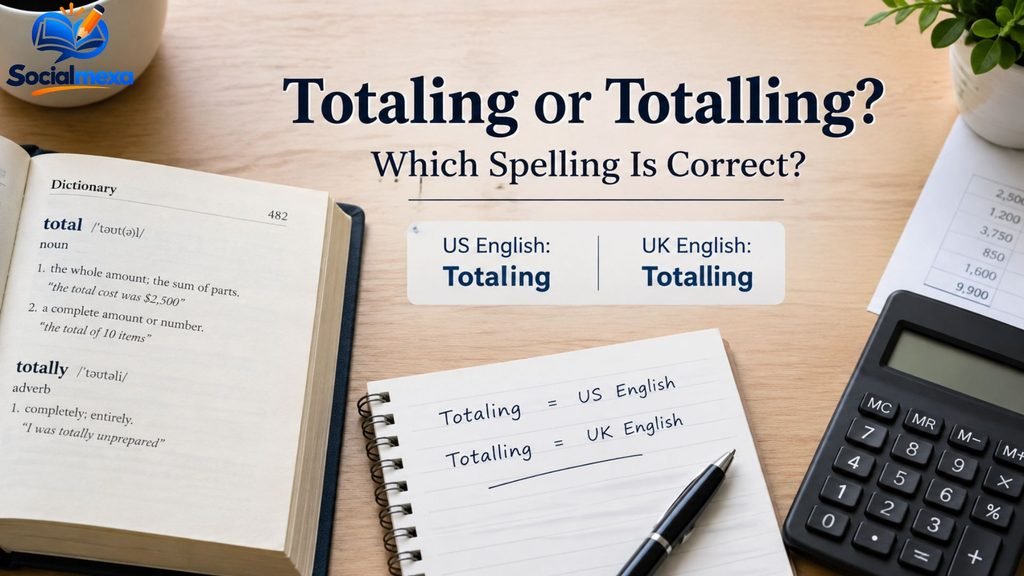
Both spellings are correct. The difference comes down to where you are writing from.
- Totaling (one L) is the American English spelling.
- Totalling (two L’s) is the British English spelling, also used in Australia, New Zealand, Canada, and most Commonwealth countries.
Neither version is a typo. Neither version is “more correct” than the other. Your choice should simply match the English convention your audience expects.
Totaling or totalling meaning
Whichever spelling you use, the meaning stays exactly the same. Totaling and totalling both describe the act of adding numbers together to reach a final sum, or the process of something reaching a certain amount. It can also describe a vehicle being damaged so severely that fixing it costs more than it is worth.
Understanding Totaling or Totalling correctly starts with knowing that both words describe the exact same action, just written differently depending on the region.
The spelling changes with geography. The meaning never does. This is one of the easiest ways to remember that you are dealing with a regional variant rather than two separate words.
What Does “Totaling” Actually Mean?
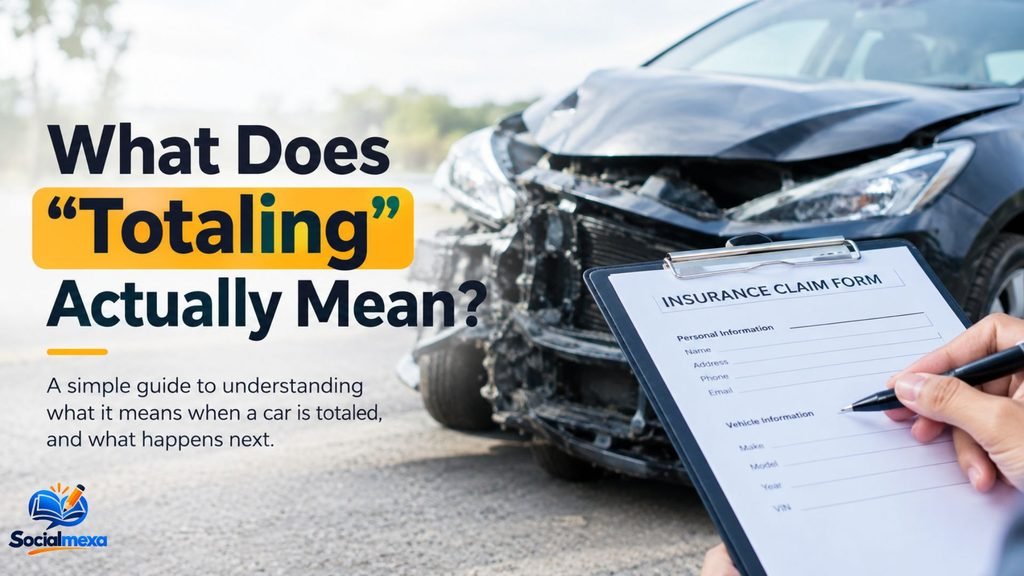
“Totaling” is the present participle form of the verb “total.” It shows up in three common situations:
- Adding up numbers — combining figures to reach a final amount.
- Reaching an amount — describing a sum that has grown to a specific figure.
- Declaring a vehicle a total loss — used mainly in insurance and accident contexts.
A few quick examples:
- The accountant is totaling the receipts before the meeting.
- Ticket sales are totaling close to ten thousand dollars.
- The insurance adjuster confirmed the car was totaling out after the collision.
Notice how the verb shifts meaning slightly depending on context, but the underlying idea of “adding up to a final figure” stays consistent.
Don’t Miss : Today’s or Todays
Totaling or totalling oxford dictionary
If you check the Oxford English Dictionary, you will find “totalling” listed as the standard British spelling, since Oxford follows British English conventions by default. American dictionaries such as Merriam-Webster list “totaling” as the primary American form.
This is actually a helpful way to remember the Totaling or Totalling split. British dictionaries generally favor the doubled consonant before “-ing,” while American dictionaries favor the single consonant. Neither dictionary marks the other spelling as wrong. They simply reflect two different national writing standards that developed over time.
Click Here To Read More Grammar
Spelling confusion like this is more common than most people realize. English is full of word pairs that split between American and British conventions, and once you understand the pattern behind one of them, you can usually predict the others. If this topic interests you, grammar resources covering American versus British spelling rules are worth bookmarking for quick reference whenever a similar word trips you up.
Totaling or totalling in english
In everyday English writing, both forms are considered standard. The choice is not about correctness but about consistency. A document written in American English should use “totaling” throughout. A document written in British English should use “totalling” throughout.
Where people run into trouble is mixing the two. If you use “totaling” in one paragraph and “totalling” in another, it signals to readers that the document was not carefully proofread, even though both spellings are technically valid on their own.
American English vs British English: Why Two Spellings Exist
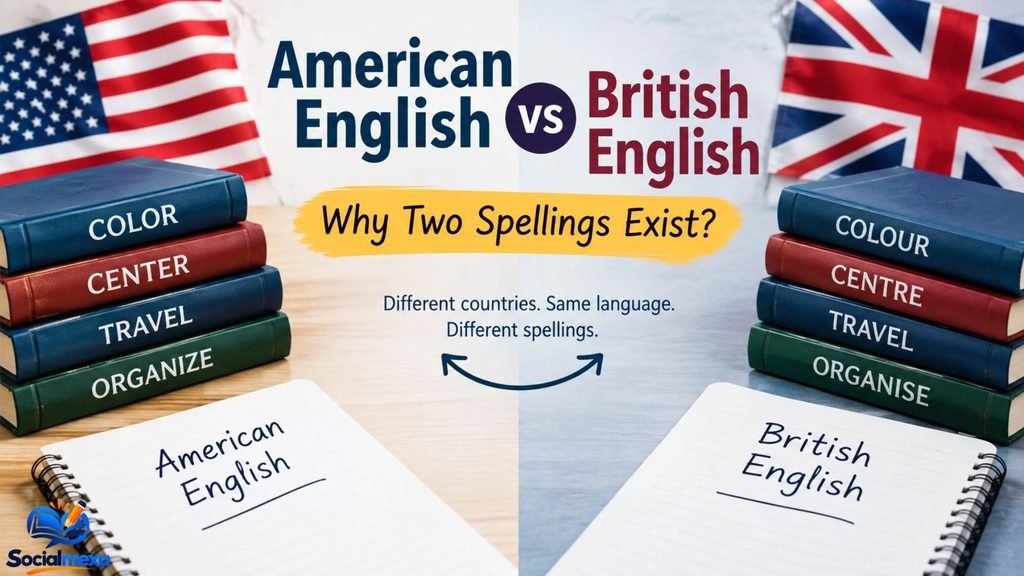
This spelling split is not random. It traces back to broader differences between how American and British English handle consonants before suffixes like “-ing” and “-ed.”
In the early nineteenth century, American lexicographer Noah Webster worked to simplify and standardize American spelling. He favored dropping unnecessary doubled letters, which is why American English gives us “color” instead of “colour,” “traveler” instead of “traveller,” and “totaling” instead of “totalling.”
British English, meanwhile, kept many of the older spelling conventions, including the practice of doubling a final consonant before adding “-ing” or “-ed,” even when the stress does not fall on the final syllable.
This is why you will consistently see:
| American English | British English |
| totaling | totalling |
| traveling | travelling |
| canceling | cancelling |
| modeling | modelling |
| labeling | labelling |
The pattern is not limited to “total.” It applies to a whole family of words ending in a single vowel plus “L.”
Totaling or totalling examples
Seeing the words in real sentences makes the difference much easier to absorb. Here are some side by side examples showing both spellings in similar contexts:
- American: The invoice is totaling $1,240 after tax.
- British: The invoice is totalling £1,240 after tax.
- American: Her monthly expenses are totaling more than her income.
- British: Her monthly expenses are totalling more than her income.
- American: The survey responses are totaling over five hundred.
- British: The survey responses are totalling over five hundred.
Same sentence structure, same meaning, only the spelling changes based on the intended audience.
The Simple Grammar Rule Behind the Single vs Double “L”
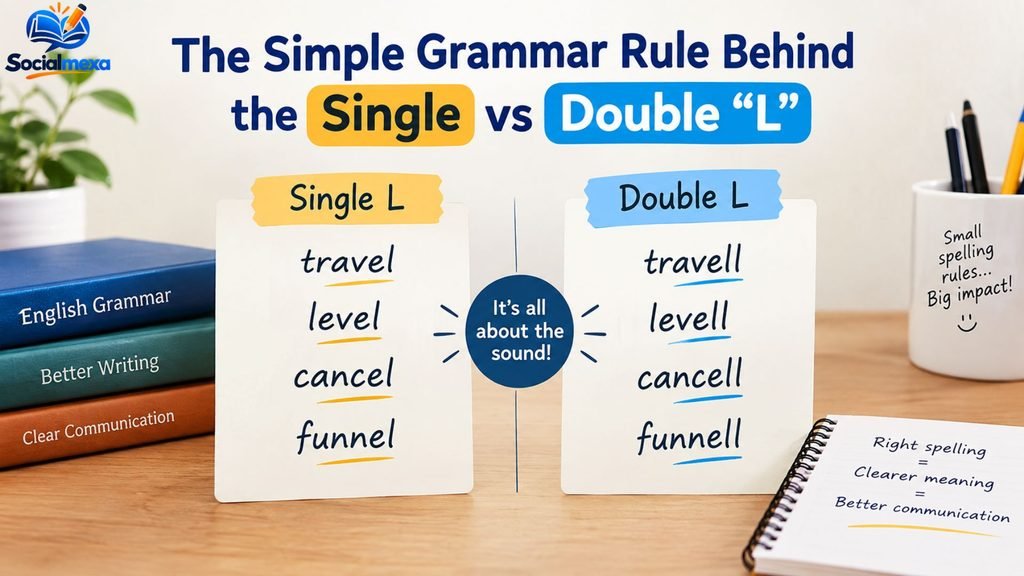
Here is the rule in plain terms:
- In American English, when a word ends in a single “L” preceded by a single vowel, that L usually stays single before adding “-ing” or “-ed,” unless the final syllable is stressed.
- In British English, that final “L” is doubled before adding “-ing” or “-ed,” regardless of where the stress falls.
Since “total” ends in an unstressed syllable with the pattern vowel plus L, American English keeps it simple: total + ing = totaling. British English doubles the consonant: total + ling = totalling.
Once you understand this pattern, deciding between Totaling or Totalling becomes almost automatic, since it is really just a matter of counting the vowel and consonant before the suffix.
This same logic explains why “begin” becomes “beginning” in both American and British English. The stress in “begin” falls on the final syllable, so both varieties double the consonant there. The rule is specifically about unstressed final syllables ending in L, which is where American and British English part ways.
Totaling or Totalling: Quick Comparison Table
| Feature | Totaling | Totalling |
| Region | United States | United Kingdom, Australia, Canada, New Zealand |
| Number of L’s | One | Two |
| Dictionary preference | Merriam-Webster | Oxford English Dictionary |
| Common use | Business, insurance, everyday US writing | Business, insurance, everyday UK/Commonwealth writing |
| Meaning | Same | Same |
Totaling or totalling car
This is one of the most common real-world uses of the word, especially in insurance conversations. When a vehicle is damaged badly enough that the cost of repairs exceeds its actual value, insurers describe it as being “totaled” (American) or “totalled” (British).
A quick text exchange shows how naturally this comes up:
Sam: How bad was the accident? Jordan: Pretty bad. The insurance company is totaling the car. Repairs would cost more than it’s worth.
In the UK, the same message would read:
Jordan: Pretty bad. The insurance company is totalling the car.
In both cases, the car is being declared a total loss, and the owner will typically receive a payout based on the vehicle’s market value rather than have it repaired.
Totaling or totalling synonym
Depending on context, a few words can stand in for “totaling” or “totalling”:
- Summing — used when combining numerical values.
- Adding up — a casual, everyday alternative.
- Aggregating — common in data and finance writing.
- Amounting to — useful when describing a running total.
When referring specifically to a vehicle, common alternatives include:
- Writing off (more common in British English)
- Declaring a total loss
- Wrecking beyond repair
Choosing the right synonym depends on whether you are talking about numbers or vehicle damage, since the two uses call for slightly different vocabulary.
Totaling pronunciation
Both spellings are pronounced the same way: TOH-tuh-ling. The extra L in the British spelling does not change how the word sounds. This is actually a helpful clue for identifying similar word pairs. When the doubled consonant does not alter pronunciation, you are usually looking at a regional spelling variation rather than two distinct words.
Real-Life Examples of “Totaling” in a Sentence
- The cashier is totaling the customer’s order at checkout.
- By the end of the quarter, sales were totaling nearly two million dollars.
- The teacher spent the afternoon totaling up the final exam scores.
- After the storm, the county was totaling the damage across multiple neighborhoods.
- The app automatically starts totaling your cart the moment you add an item.
Totaling or totalling grammar
Grammatically, “totaling” and “totalling” function identically. Both are present participles, meaning they can act as:
- Part of a continuous verb tense: “The store is totaling receipts.”
- An adjective: “The totaling process took over an hour.”
- A gerund in some constructions: “Totaling expenses by hand is time consuming.”
The only grammatical detail worth remembering is spelling consistency. Once you pick American or British conventions for a document, stick with that choice for every related word, including “totaled/totalled,” “canceling/cancelling,” and “traveling/travelling.”
Real-Life Examples of “Totalling” in a Sentence
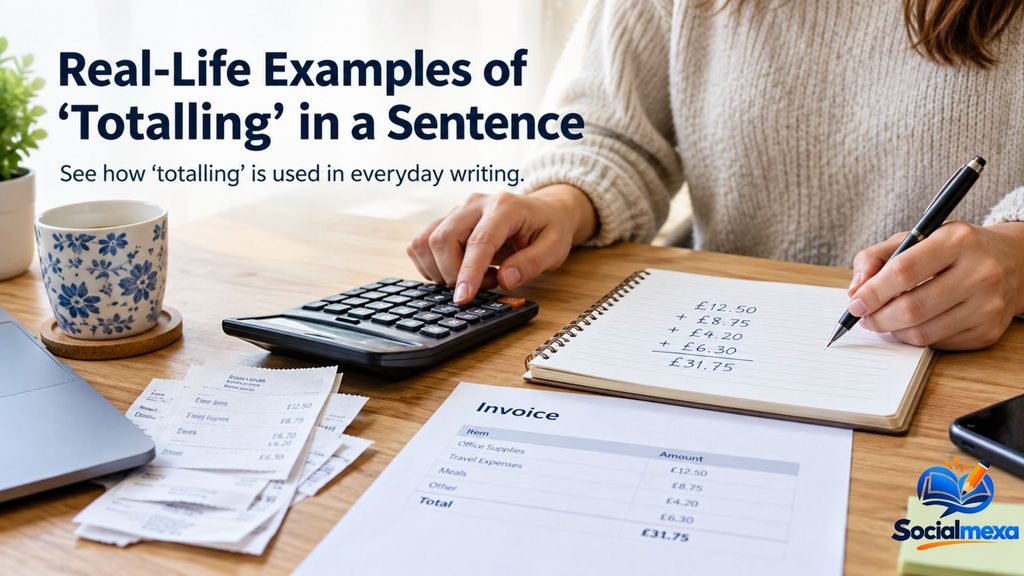
- The accounts department spent the morning totalling last month’s invoices.
- Donations were totalling well over ten thousand pounds by the end of the event.
- The mechanic confirmed the damage was totalling more than the car’s resale value.
- She kept totalling her shopping list before reaching the till.
- The committee is still totalling the votes from the regional election.
Historical Origin of the Word “Total”
The word “total” traces back to the Latin word “totalis,” which relates to “totus,” meaning “whole” or “entire.” It entered English through French during the medieval period, carrying the same core idea of wholeness or completeness. Over time, English speakers adapted it into a verb, giving us “total” as both a noun (a final sum) and a verb (to add up to a final sum).
The “-ing” form followed naturally as English writers needed a way to describe the ongoing action of reaching that total. The spelling split between “totaling” and “totalling” came much later, as American and British English developed their own separate conventions for handling suffixes.
Common Mistakes People Make With This Word

- Mixing spellings in the same document. Using “totaling” in one section and “totalling” in another looks inconsistent, even though both are technically correct on their own.
- Assuming one spelling is wrong. Neither version is a mistake. The error only happens when the spelling does not match the intended regional audience.
- Confusing it with “totalled” in the wrong tense. “Totaling/totalling” is the present participle, while “totaled/totalled” is the past tense. Mixing these up changes the grammar of the sentence.
- Overcorrecting after learning the rule. Some writers, once they learn British English doubles the L, start doubling consonants in other American-spelled words where it does not apply.
Which One Should You Use?
The simplest approach is to match your spelling to your audience:
- Writing for a US-based company, client, or publication? Use totaling.
- Writing for a UK, Australian, Canadian, or other Commonwealth audience? Use totalling.
- Writing for a global audience with no clear regional lean? Pick one spelling and use it consistently throughout the entire piece.
Most word processors and content management systems in 2026 include built-in language settings that will automatically flag inconsistent spelling once you choose US or UK English, which makes staying consistent easier than ever if you simply set your document language correctly from the start.
Whether you are writing for a business report or a casual email, deciding on Totaling or Totalling ultimately depends on one simple factor: who is going to read it.
Related Words That Follow the Same Rule
Once you understand the pattern behind “totaling” and “totalling,” you can apply it to a whole group of similar words:
- traveling / travelling
- canceling / cancelling
- modeling / modelling
- labeling / labelling
- fueling / fuelling
- signaling / signalling
In every case, American English keeps the single L, while British English doubles it before adding “-ing” or “-ed.”
FAQs About Totaling or Totalling
What does totalling mean?
Totalling is the British English spelling of the verb form describing the act of adding numbers to reach a final sum, or describing something (such as a vehicle) that has been damaged beyond reasonable repair. It means the same thing as the American spelling “totaling.”
Does totaling have one L or two?
Totaling has one L. This is the standard American English spelling. The British English version, totalling, has two L’s.
How do you use totalling in a sentence?
You can use it to describe an ongoing calculation or an accumulating amount. For example: “The accountant is totalling the receipts before the meeting” or “Damages were totalling more than expected after the storm.”
Which is correct, totalled or totaled?
Both are correct, depending on region. “Totaled” is the American English past tense spelling with one L. “Totalled” is the British English past tense spelling with two L’s. The choice follows the same regional rule as totaling versus totalling.
Final Takeaway
Totaling and totalling are not competing spellings where one is right and one is wrong. They are simply two versions of the same word shaped by American and British spelling traditions. Use “totaling” for American audiences and “totalling” for British and Commonwealth audiences, keep your choice consistent throughout your writing, and you will never need to second guess this word again.
At the end of the day, choosing between Totaling or Totalling simply comes down to matching your spelling with your audience’s regional English convention.

Emily Carter is an English language writer who creates simple guides on grammar, word meanings, spelling, slang, and everyday English. Her goal is to make confusing language topics clear, practical, and easy to understand.
