


You typed a word, stared at it, and now it looks wrong. Was it bellow or below? Your brain says both look fine, which is exactly why this pair keeps tripping people up. One extra letter can turn “see the notes below” into “see the notes roaring at you.” Here is the fix in plain English.
Bellow or Below: Quick Answer
Below means lower than something, and it has one L in the middle. Bellow means to shout in a deep, loud voice, and it has two Ls. If you are pointing to something lower on a page, a shelf, or a thermometer, write below. If someone is roaring like an angry bull, write bellow.
Here is the shortcut: if you can replace the word with “underneath” or “lower,” you need below. If you can replace it with “roar” or “shout,” you need bellow.
Bellow Meaning: A Loud, Deep Roar

To bellow is to make a deep, powerful sound. People bellow when they are angry, excited, or trying to be heard across a noisy room. Animals bellow too. Bulls, cows, elephants, and moose all do it, usually without apologizing.
The word works as both a verb and a noun. As a verb, it describes the action of roaring. As a noun, it describes the sound itself. In both cases the sound is big, low, and hard to ignore.
| Keep Reading These Articles |
| Customize or Customise? Discover the Correct Spelling |
| Emphasize or Emphasise: Which Spelling Is Correct UK vs USA |
| Useing or Using? Learn the Correct Spelling Fast |
How to Use “Bellow” in a Sentence
Use bellow when someone or something produces a loud, booming sound. Here are a few clean examples:
- The coach had to bellow across the field to be heard over the crowd.
- I heard a bellow from the barn and knew the cow wanted dinner.
- “Get off my lawn!” he bellowed at the delivery driver.
- The referee let out a bellow that silenced the whole gym.
Notice that bellow often shows up with shouted words, angry speech, or animal noises. It carries more force than “say” and more volume than “call.”
Bellows: The Noun Form
Now for a curveball. Bellows with an S is a separate noun, and it has nothing to do with shouting. A bellows is a tool that pumps air. You have probably seen one next to a fireplace. Blacksmiths use them to feed air into a fire. Accordions and old cameras use them too.
Here is how it looks in a sentence:
- He pumped the bellows until the coals glowed orange.
- The old camera had a folding bellows between the lens and the film.
One quirk: “bellows” is a singular noun that looks plural. You can say “a bellows” or “two bellows.” So the word bellows belongs to the air pump, not to the roar.
Below Meaning: Lower Than Something Else

Below tells us where something sits compared with something else. It means lower in position, lower in rank, or lower in amount. It works as an adverb (below, meaning underneath) and as a preposition (below the surface, meaning beneath it).
Think of it as the opposite of above. If a plane flies above the clouds, the clouds float below the plane. If the temperature is under zero, it is below zero. Simple.
How to Use “Below” in a Sentence
Use below when you talk about position, level, rank, or amount. These examples cover the usual cases:
- Position: The basement is below the kitchen.
- Written text: Please read the instructions below before you start.
- Temperature: It dropped below freezing overnight.
- Rank: A sergeant ranks below a lieutenant.
- Amount: Your score fell below the passing mark.
Below can also stand alone at the end of a sentence. “The water flows quickly, and the rocks lie below.” No object is needed, because the position is clear from context.
The Origin of Bellow or Below
These two words look like cousins, but they come from different families. That is good news for your memory, because different roots mean different jobs.
The Etymology of “Bellow”
Bellow comes from Middle English, probably from an older word meaning “to roar” or “to bark.” It has roots that stretch back to Old English and other Germanic languages. The word is also linked in sound and spirit to the word bell, which makes sense. A bell makes a loud, ringing noise, and a bellow does the same job with a throat.
The noun bellows has its own history. It comes from an Old English word for “bag,” which is also the ancestor of belly. Picture a leather bag that puffs air. That is a bellows. You can even spot a Bible connection here. The prophet Jeremiah describes a furnace and bellows in Jeremiah 6:29, using the image of a refiner’s fire. That is one of the oldest and clearest examples of the bellows in written history.
The Etymology of “Below”
Below is simpler. It formed in Middle English by joining by and low. In other words, “by low,” meaning at a lower place. Over time, the two parts merged into one word, and the spelling settled at below.
That gives you a handy clue: the word below literally contains low. If you mean lower, the word already tells you so.
A fun historical footnote: the American writer Saul Bellow won the Nobel Prize in Literature in 1976. His surname is spelled with two Ls, and no, it does not mean he wrote everything at high volume. It is just a family name that shares its spelling with our noisy verb.
Bellow or Below Pronunciation
Good news: these words do not sound alike, even though they look alike. Once you hear the difference, the spelling gets easier Bellow or Below.
- Bellow sounds like BEL-oh. The stress lands on the first syllable.
- Below sounds like bih-LOH. The stress lands on the second syllable.
Say them aloud. Bellow starts with a strong “bel” like the bell in a church tower. Below starts with a soft “bih” and rises into “loh.”
That stress pattern works like a built in clue. If you hear the first syllable pop, you are dealing with the loud word. If the second syllable carries the weight, you are dealing with the position word.
British English vs. American English Spelling
Here is a relief. There is no difference between British and American English for either word. Bellow is bellow in London, Lahore, and Los Angeles. Below is below everywhere.
Many spelling pairs do split across the Atlantic. Think color and colour, or center and centre. But bellow and below skip that drama entirely.
The confusion is not a regional problem. It is a typing and hearing problem. People mix these words up because they sound close in fast speech and look close in print.
So whichever version of English you write, follow the same rules:
- Use below for lower positions and amounts.
- Use bellow for loud, deep shouts.
- Use bellows for the air pumping tool.
Most errors come from one direction: people write bellow when they mean below. Spell checkers usually miss it, because both are real words. Let us look at the usual slips.
❌ Wrong: “Please see the instructions bellow.”
This is the most common mistake online. The writer wants to point to text lower on the page, which means they need below.
✓ Right: “Please see the instructions below.”
Below has one L in the middle and points down the page. Nobody needs a roar here.
❌ Wrong: “The crowd started to below in excitement.”
This one goes the other way. Below cannot be a verb for making noise. The writer means a loud, cheering roar.
✓ Right: “The crowd started to bellow in excitement.”
Bellow is the verb for loud, deep sound. The crowd can bellow. It cannot be below.
✓ Right (But Often Wrongly “Fixed”): “His voice was a low bellow as he read the notes.”
This sentence is actually correct. Some writers see the word “low” next to bellow and think a spelling error slipped in. It did not. A “low bellow” is a deep, rumbling shout. Do not change it.
❌ Wrong: “Temperatures fell bellow zero.”
A thermometer does not roar. It drops. The correct word is below.
✓ Right: “Temperatures fell below zero.”
Any time you talk about temperature, rank, level, or position, choose below.
“Please See Below” or “Please See Bellow”?
Write “Please see below.” Every time. This phrase appears in emails, forms, contracts, and instructions, and it always means “look at the text placed lower on this page or message.”
The bellow version is a mistake, and it is a surprisingly common one. Search engines even show people looking up this exact phrase, which tells us many writers doubt themselves at the last second.
Here are some safe, correct ways to use the phrase:
- Please see below for the schedule.
- Details are listed below.
- The steps below explain the process.
You may also wonder about “as below.” It is correct and widely used in business writing, especially in British English. For example: “The results are as below.” If you want a warmer, clearer style, “as follows” or “listed below” often reads better. But “as below” is not wrong.
Bellow or Below in Everyday Examples
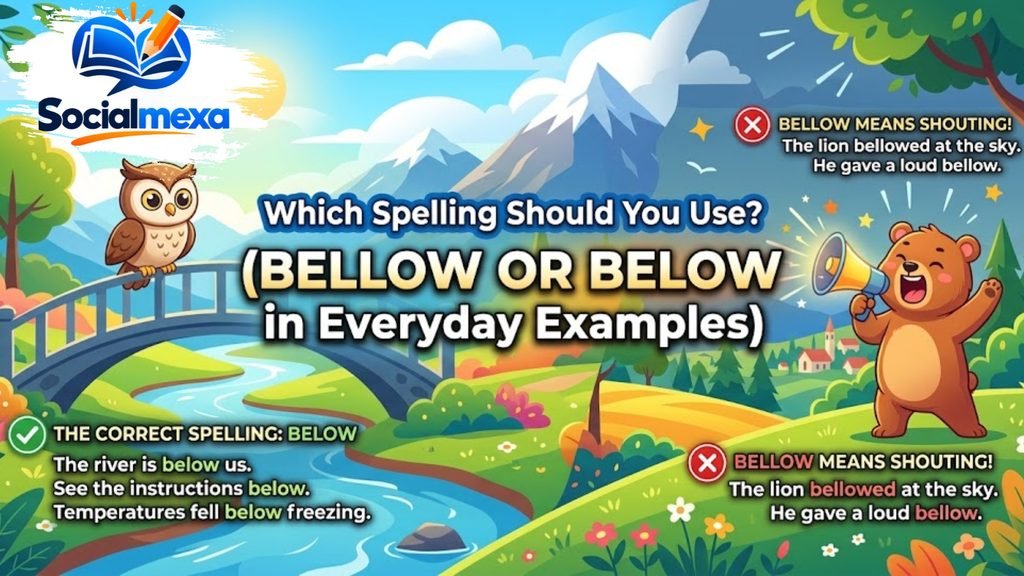
Real life gives us plenty of practice. Here are common situations where each word shows up.
Where below appears:
- Weather reports: “Lows will drop below 20 degrees tonight.”
- Emails: “See my notes below.”
- Travel: “The village sits in a valley below the mountain.”
- Work: “Sales came in below target this quarter.”
- Ships: “The crew went below deck to wait out the storm.”
Where bellow appears:
- Sports: “The fans bellow when their team scores.”
- Farms: “The bull started to bellow at sunrise.”
- Stories: “The captain would bellow orders across the deck.”
- Family life: “Dinner!” my dad would bellow up the stairs.
Notice a pattern. Below almost always describes where or how much. Bellow almost always describes how loud. If you can attach a volume knob to the sentence, you want bellow. If you can attach a ruler, you want below.
Bellow or Below: Search Trends and Usage Data
Here is what usage tells us. The word below is far more common in English than bellow. It appears constantly in everyday writing, from forum posts to legal documents, while bellow shows up mostly in fiction, sports coverage, and animal descriptions.
That imbalance explains a lot of the confusion. When people search “bellow or below,” most of them are not looking for a word about roaring bulls. They are checking a spelling they typed in a hurry, usually in a phrase like “see below.” The search itself is a sign of a typo scare.
I do not have live Google Trends numbers to quote here, and I would rather not invent any. If you want current figures, open Google Trends and compare “bellow” against “below.” You will see the gap right away, and you can filter by country to see how the interest changes.
Two takeaways stand out from the pattern:
- Writers rarely look up below, because they use it so often.
- Writers double check bellow, because it feels rare and slightly dramatic.
Which Spelling Should You Use?

Ask yourself one question: is this about a position, or is it about a sound? Position means below. Sound means bellow.
Here is a side by side view to lock it in:
| Feature | Bellow | Below |
| Part of speech | Verb and noun | Adverb and preposition |
| Meaning | To roar, or a deep loud shout | Lower than, underneath |
| Number of Ls | Two | One |
| Pronunciation | BEL-oh | bih-LOH |
| Example | The bull began to bellow. | See the chart below. |
| Related form | Bellows (air pump) | Above (opposite) |
Now for the memory tricks:
- Bellow has two Ls because it is twice as loud. A big sound deserves a big spelling.
- Below is “low” inside it. Low tells you the word points downward.
- Bell plus low: A bellow is a bell like, low toned roar.
Still unsure? Read your sentence out loud. If you want to shout it, use bellow. If you would point down at it, use below.
FAQs About Bellow or Below
What is a bellow used for?
The word bellow can refer to two things. As a verb or noun, it describes a loud, deep shout or animal roar. As the noun bellows, it names a tool that pumps air into a fire, an organ, an accordion, or an old camera. If someone asks what a bellows is used for, the answer is to push air where it is needed.
Is it correct to say “as below”?
Yes. “As below” is correct and common in formal and business writing. It means “as shown lower on the page.” If you want a friendlier tone, try “as follows” or “listed below.” Both keep the meaning clear.
What does “bellow” mean?
Bellow means to make a deep, loud, roaring sound. People bellow when they shout with force, and animals like bulls and elephants bellow as part of their natural calls. It is not the same as below, which describes a lower position.
What is the spelling below?
The correct spelling is below, with one L in the middle and the stress on the second syllable. It is the word you use for “underneath,” “lower than,” or “see the text lower on this page.”
Conclusion (Bellow or Below)
Bellow and below are two different words with two different jobs. Bellow is for loud roars, and it has two Ls because a big sound needs a big spelling. Below is for lower positions, and it has “low” tucked right inside.
Next time you write “see below,” you can hit send with confidence. And if a bull ever shows up in your writing, you know just which word to grab.

Emily Carter is an English language writer who creates simple guides on grammar, word meanings, spelling, slang, and everyday English. Her goal is to make confusing language topics clear, practical, and easy to understand.
2 thoughts on “Bellow or Below? Discover the Correct Spelling Fast”