


You typed “customize,” and a red squiggle appeared. You switched to “customise,” and the squiggle moved to a different word. Annoying. Here is the short version: both spellings are correct. “Customize” is standard in American English, and “customise” is standard in British English. The word means the same thing either way, so your audience decides which one you use.
Let’s sort out the details so you never second guess it again.
Customize
Customize is the American spelling. It appears in US dictionaries, US software, and US websites. Canadian writers also lean toward it.
Customise
Customise is the British spelling. It is standard in the UK, Ireland, Australia, New Zealand, and much of South Asia and Africa.
Customize or Customise App
Apps are where most people first meet this spelling debate. Open Settings on almost any phone and you will find a button labeled “Customize.” That is because most major apps are built by US companies, so the interface uses American spelling by default.
The good news is that many apps switch automatically. Set your phone to British English and “Customize” becomes “Customise” in menus that support it. If you build an app, pick one spelling per language version and keep it everywhere. We will come back to that in the mistakes section.
Customize or Customise: Quick Answer
Use customize if your readers are American or Canadian. Use customise if your readers are British, Australian, Irish, or from New Zealand. If your audience is mixed, pick the one that matches your largest group and stay consistent.
That single rule solves about 95% of cases. The rest of this article covers the other 5%, plus the meaning, the history, and the traps.
| More Helpful Articles |
| Proove or Prove? Find the Correct Spelling Fast |
| Likeable or Likable: Which Spelling Is Correct? |
| Skis or Skiis? Discover the Correct Spelling & Meaning |
Meaning of “Customize or Customise”
To customize something means to change it so it fits a specific person, need, or purpose. You start with something standard and adjust it.
Think of a pizza. The plain cheese pizza is the standard version. Once you add mushrooms, skip the olives, and ask for extra sauce, you have customized it.
Here is a quick way to remember the meaning:
- Standard version: made for everyone
- Customized version: adjusted for you
Examples
Both spellings work in the same sentences. Only the letter changes.
- US: “You can customize the dashboard to show only your top metrics.”
- UK: “You can customise the dashboard to show only your top metrics.”
- US: “We customize every wedding cake to match the couple’s theme.”
- UK: “We customise every wedding cake to match the couple’s theme.”
Notice that nothing else in the sentence changes. This is a spelling choice, not a grammar rule.
Customize or Customise Clothing
Clothing is one of the biggest places you will see this word. Tailors have adjusted garments for centuries, but online stores turned it into a whole category. Custom shirts, printed hoodies, embroidered caps, and made to measure suits all fall here.
A US store might say, “Customize your hoodie with your name.” A UK store would say, “Customise your hoodie with your name.” A shopper in Manchester who sees the American version will still understand it. They just may notice it looks slightly foreign.
That small mismatch matters for trust. Fashion buyers often decide in seconds, and a spelling that feels local helps a shop look local.
The Origin of Customize or Customise
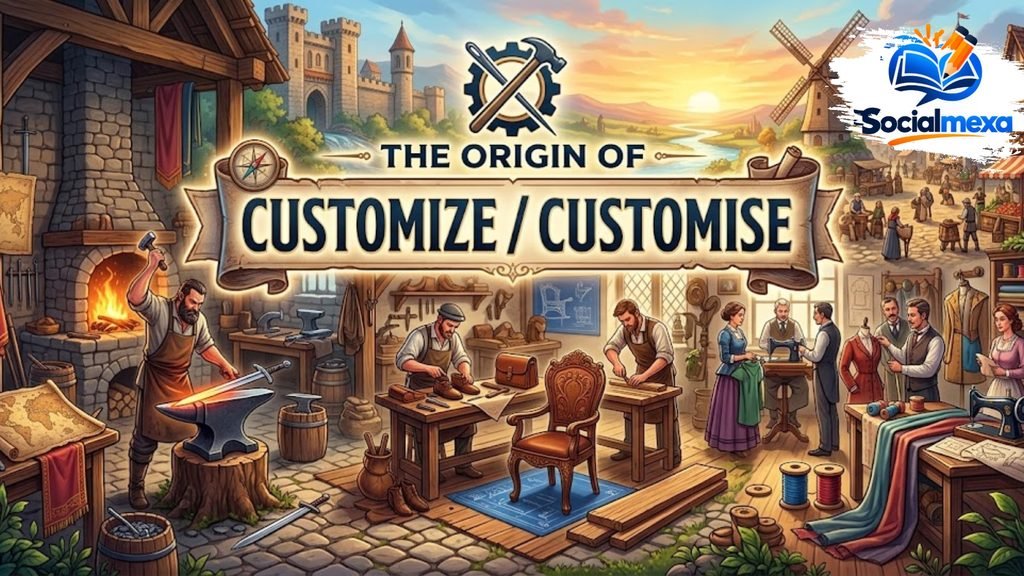
To understand why two spellings exist, you need to look at where the word comes from.
It starts with the noun custom, which entered English from Old French around the 1200s. The French word traces back to Latin roots meaning habit or usual practice. A “custom” was the way something was normally done. Later, “custom made” came to describe items built to a buyer’s own wishes instead of the usual pattern.
The verb form arrived when English speakers attached a common verb ending to “custom.” That ending comes from the Greek suffix izein, which passed through Latin and then French, where it became iser. English borrowed the ending and could spell it two ways.
As for biblical context, there is none for this particular word. It is a much later English creation, and it belongs to the history of trade and manufacturing more than scripture. The history that matters here is the story of how English spelling split across the Atlantic.
British English vs American English Spelling
The split is mostly the work of one man. In the early 1800s, an American writer and lexicographer named Noah Webster pushed for simpler, more phonetic spelling. His dictionaries helped standardize forms like “color” instead of “colour” and “center” instead of “centre.” The “ize” ending became the American default.
Britain kept more of the French influenced forms, and “ise” became the everyday standard there. The result is the two camps we have today.
Comparison Table
| Feature | Customize | Customise |
| Region | US, Canada | UK, Ireland, Australia, New Zealand |
| Verb ending | ize | ise |
| Noun form | customization | customisation |
| Adjective | customizable | customisable |
| Past tense | customized | customised |
| Meaning | Same | Same |
Why Do Both Spellings Exist?
Because English never had a single referee. Different countries built different dictionaries, and each set its own habits.
Here is a twist that surprises many people. The “ize” spelling is not purely American. Some British publishers, including Oxford University Press, use “ize” for many words based on the Greek origin. It is often called Oxford spelling. So you may see “customize” in a British book and it is not an error.
That is why I would not call “customize” wrong in the UK. It is just less common in everyday writing there.
Customize Order Meaning
“Customize order” appears constantly in food apps, online shops, and print services. It means you can change the details of your order before you buy.
A few examples:
- Coffee shop: oat milk, extra shot, no foam
- Online printer: choose paper type, size, and finish
- Furniture store: pick the fabric, leg color, and dimensions
A related phrase is “custom order,” which usually means the item is made from scratch for you. “Customize order” often means you adjust an existing product. The difference is small, but it helps when you write button labels. A button that says “Customize Order” sets the right expectation: you are changing options, not commissioning something new.
Customisation in Business
Once you see how the word works in shops, its business value becomes clear. Companies use customisation to make a product feel built for one buyer instead of ten thousand.
Common examples include:
- Software: custom dashboards, workflows, and reports
- Manufacturing: made to order parts and configurable products
- Marketing: tailored offers based on customer behavior
- Services: packages built around a client’s goals
The business case is simple. People pay more, stay longer, and complain less when a product fits them. That is why “customisation options” is a feature that sales pages love to highlight.
If your company sells globally, the spelling choice becomes part of your brand voice. A UK software firm may write “customisation,” while its US site says “customization.” Both are correct. Neither is a mistake, as long as each site stays consistent.
Which Spelling Should You Use?
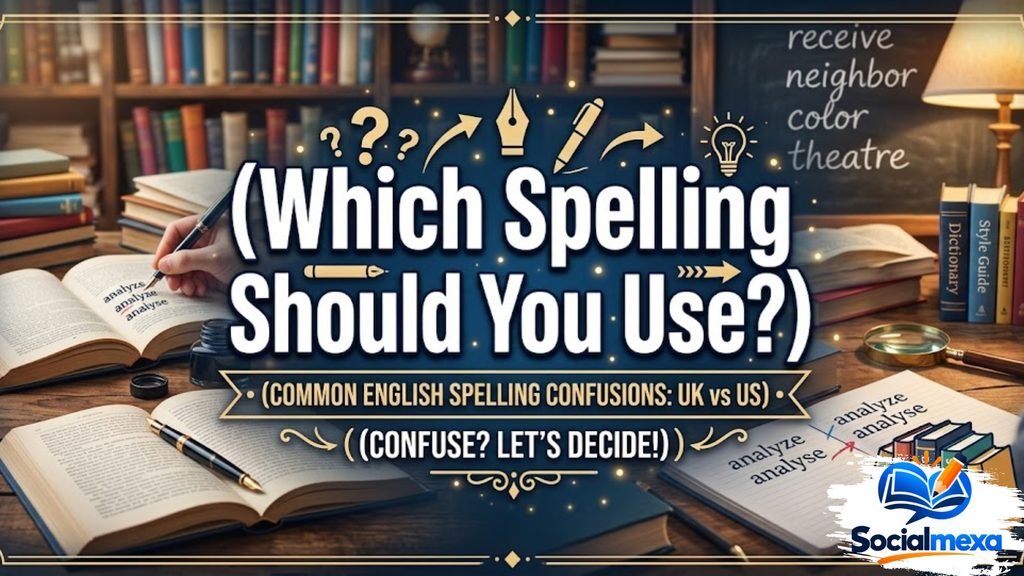
Now for the practical part. Your choice depends on who is reading.
For American English
Use customize, customized, customization, and customizable. This also works for Canadian audiences in most cases.
For British English
Use customise, customised, customisation, and customisable. This fits the UK, Ireland, Australia, New Zealand, and most Commonwealth style guides. Pakistan and India also follow British conventions in most formal writing.
For International Audiences
When your readers come from many countries, pick based on your main market. If you cannot tell, go with customize. It is the form used in most software interfaces, so global users see it more often, and it is accepted by British readers who know Oxford spelling.
For Business and Marketing Content
Match your target customer, not your own location. A designer in Lahore selling to US clients should write “customize.” A US agency pitching UK clients should write “customise.” Check your audience analytics if you are unsure. It takes two minutes and prevents awkward edits later.
Common Mistakes with Customize or Customise
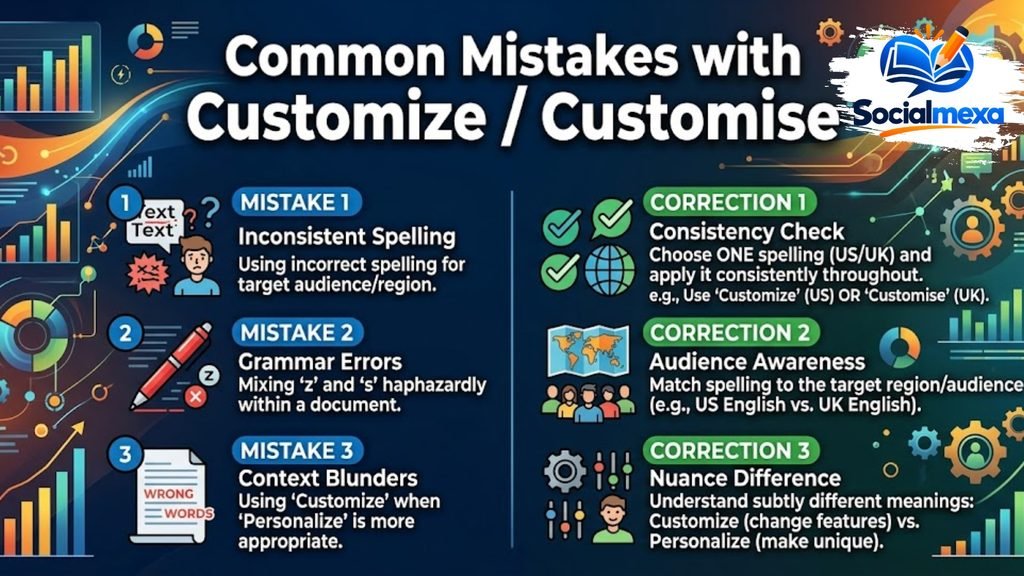
Knowing the rules is easy. Applying it every time is harder. These are the mistakes that show up most.
Mistake 1: Mixing UK and US Spellings
This is the classic slip. A paragraph says “customise the layout” and then “color options” in the next line. Check the whole family: colour, favourite, centre, organise, realise. If one is British, they should all be British.
Mistake 2: Using Different Spellings on the Same Website
The homepage says “Customize,” the product page says “Customise,” and the checkout says “Customize” again. Visitors notice this even if they cannot explain why the site feels sloppy. Search engines can also treat the variations as separate terms. Pick one and set it in your style guide.
Mistake 3: Confusing “Customize” with “Personalize”
They overlap, but they are not identical. We will cover this in detail below, so hold that thought.
Mistake 4: Ignoring Audience Location
Writing in your own habit instead of your reader’s is the most common mistake of all. Spellcheck will not save you. It only checks against the language setting you chose.
A quick fix: set the correct language in your editor. Choose English (US) or English (UK) before you write, and the software does the policing for you.
Customize Translate
People often search for the translation because they want the meaning in another language. Here are natural equivalents:
- Urdu: اپنی مرضی کے مطابق بنانا
- Hindi: अपनी ज़रूरत के अनुसार बनाना (or अनुकूलित करना)
- Spanish: personalizar
- French: personnaliser
- German: anpassen
Notice something interesting. Spanish and French use words that look like “personalize,” not “customize.” Many languages treat the two ideas as one. English is the one that draws a line between them, which is why the next sections matter.
Customize or Customise in Everyday Examples

Let’s move from theory to real writing. Here is how the word looks in daily use, with a US and UK version for each.
Websites and Apps
- US: “Customize your homepage in Settings.”
- UK: “Customise your homepage in Settings.”
Keep button labels short. “Customize” alone is usually enough.
Emails
- US: “We have customized this proposal for your team.”
- UK: “We have customised this proposal for your team.”
In emails, the spelling signals care. A client who sees their own regional spelling feels the message was written for them.
Social Media
- US: “Customize your feed and mute what you don’t need.”
- UK: “Customise your feed and mute what you don’t need.”
Social posts are casual, so a mixed spelling is less serious here, but brands should still stay consistent.
Business Documents
- US: “The customization plan includes three stages.”
- UK: “The customisation plan includes three stages.”
Formal documents get scrutiny. Reports, contracts, and proposals should follow one style guide from start to finish.
Product Descriptions
- US: “Fully customizable with 12 color options.”
- UK: “Fully customisable with 12 colour options.”
Product pages are where spelling and sales meet. A shopper who feels understood buys sooner.
Customisable or Customizable
This one trips people up because there is an extra layer. The adjective follows the same regional rule as the verb:
- Customizable: American
- Customisable: British
One handy detail: you drop the “e” from the verb before adding “able.” So “customize” becomes “customizable,” not “customizeable.” The same goes for the British form, where “customise” becomes “customisable.”
If you write “customizeable,” you are not in either camp. Fix it and move on.
Customize vs Personalize: What’s the Difference?
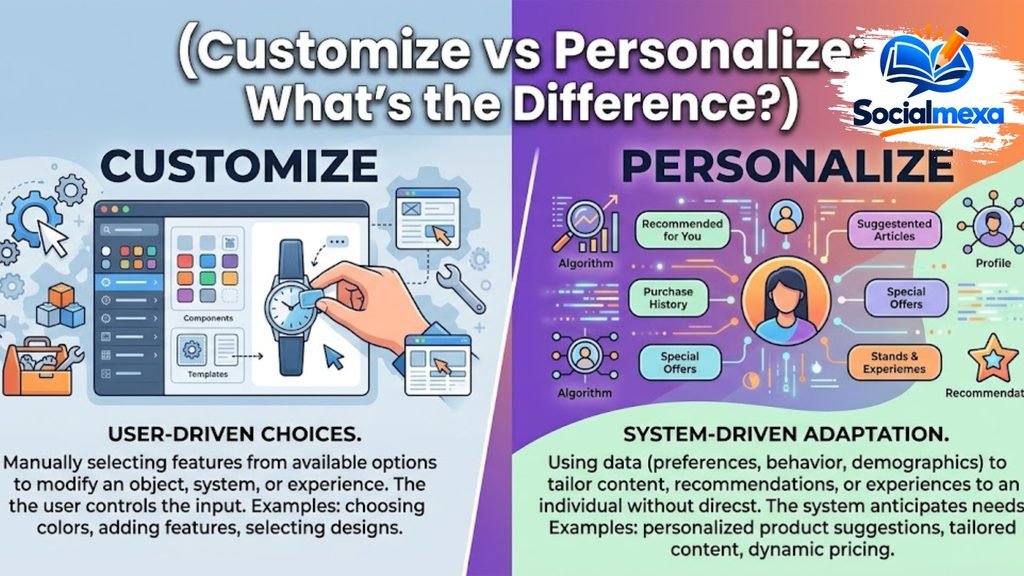
These two words sit close together, and people swap them all the time. The difference is small but real.
Customize means to change something to suit a purpose or preference. It often involves choices the user makes.
Personalize means to tailor something to one specific individual, often by using their name, history, or data.
| Situation | Better word |
| Choosing colors for your phone case | Customize |
| Printing your name on the case | Personalize |
| Rearranging your app dashboard | Customize |
| An email that greets you by name | Personalize |
A simple test: if the change is about options, use customize. If it is about identity, use personalize.
Both words also have the same spelling split. “Personalise” is the British form, so the same regional rule applies.
Customize or Customise: Google Trends and Usage Data
Spelling questions are easier to settle with real data. Here is what usage patterns generally show, and how you can check them yourself.
Search Popularity by Country
In general, customize dominates worldwide search volume. The reason is not that everyone loves American spelling. It is that software, apps, and tech products use it, so people meet the word in that form first. “Customise” is stronger in the UK, Australia, New Zealand, and Ireland.
To verify current numbers, open Google Trends, type both spellings, and compare by country and time range. Trends data changes, so treat it as a live check instead of a fixed fact.
Usage in Published Content
Across published English, “customize” appears far more often than “customise” in large text collections such as Google Books, which leans toward American publishing. In British news and magazine writing, “customise” is the normal form, with “customize” appearing mainly in tech coverage and in publishers that follow Oxford spelling.
The takeaway: neither spelling is fading. Each is stable inside its own region.
Comparison Table: Customize or Customise
Here is the whole picture in one place.
| Word form | American English | British English |
| Verb | customize | customise |
| Past tense | customized | customised |
| Present participle | customizing | customising |
| Noun | customization | customisation |
| Adjective | customizable | customisable |
| Main regions | US, Canada | UK, Australia, NZ, Ireland |
| Common in | Software, tech, US retail | UK press, UK retail, Commonwealth writing |
Save this table for your style guide. It settles every future argument in about ten seconds.
Customise Chrome
Here is a concrete example that ties everything together. Google Chrome uses the American spelling, so the feature is called Customize Chrome, even when you use it in the UK.
To use it:
- Open a new tab in Chrome.
- Look for the Customize Chrome button, usually at the bottom right of the page.
- Choose a theme, color, or background image.
- Adjust shortcuts and cards to match your habits.
You can also open Chrome settings and go to the appearance section to change themes, fonts, and toolbar options.
Menu layouts change with updates, so if you do not see the button right away, check Chrome’s help page for the latest steps. This is also a nice reminder that big tech brands often keep American spelling globally, even when local versions exist.
How to Choose the Right Spelling for Your Audience

Now you know the rules, the history, and the traps. Here is a fast decision path you can follow:
- Check your main audience. Where do most of your readers live?
- Check your platform. Does your CMS, app, or brand already use one form?
- Set your editor language. Choose English (US) or English (UK) before writing.
- Write a one line style rule. Example: “We use American spelling everywhere.”
- Search and replace before publishing. Scan for the other version and fix any strays.
If two people on your team disagree, do not argue about which is more correct. Both are. Just pick one and write it down. Peace restored.
FAQs About Customize or Customise
What is meant by customise?
Customise means to change something so it fits a particular person, need, or purpose. It is the British spelling of “customize.” The meaning is identical in both versions. For example, “She customised her bike with a new seat and bright handlebars.”
How do you spell “customize” in English?
The spelling is c-u-s-t-o-m-i-z-e. That is the American form. In British English, it is c-u-s-t-o-m-i-s-e. Both are correct, and the choice depends on your audience.
Which is correct, personalized or customized?
Both are correct, but they mean slightly different things. Customized means adjusted to suit a need or preference. Personalized means tailored to a specific individual, often with their name or details. A hoodie with your chosen color is customized. A hoodie with your name on it is personalized.
What is another word for “customize”?
Good alternatives include tailor, adapt, adjust, personalize, modify, and tweak. Pick the one that matches your tone. “Tailor” sounds polished, “tweak” sounds casual, and “adapt” sounds practical.
Conclusion
Here is the whole answer in one breath: customize is American, customise is British, and both mean the same thing. Choose based on your readers, stay consistent across your content, and use “personalize” only when the change is about one specific person.
Spelling is a small detail, but small details shape how professional your writing feels. Now you can pick the right form with confidence and get back to the more interesting part, which is actually customizing something.

Emily Carter is an English language writer who creates simple guides on grammar, word meanings, spelling, slang, and everyday English. Her goal is to make confusing language topics clear, practical, and easy to understand.
5 thoughts on “Customize or Customise? Discover the Correct Spelling Fast”