


You just came back from the slopes, you’re typing a quick recap for your friends, and suddenly your fingers freeze halfway through a word. Did you ski yesterday, or did you skied yesterday? And what in the world is skiied? If your brain just short circuited, you’re not alone. This tiny word trips up more writers than steep black diamond runs trip up beginners.
Here’s the short version before we go deeper: skied is correct. Skiied is not a real word, no matter how many times autocorrect lets it slide.
Skied
Skied is the correct past tense and past participle of the verb “ski.” It follows a small but real spelling rule in English, and once you see it, you’ll never forget it.
Skiied
Skiied looks like it should be right because so many past tense verbs double up on letters. But this one is a spelling myth. It shows up in casual texts and social posts, yet no dictionary recognizes it as standard English.
Skied or skiied meaning
Both words are trying to say the same thing: that someone skied down a mountain, hill, or slope in the past. The meaning isn’t in question here, only the spelling is.
Skied means “went skiing” or “traveled on skis” at some point before now. It’s simply the past form of the action verb “ski.”
Skiied carries the same intended meaning, but it’s a misspelling. Think of it like writing “receive” instead of “receive.” People understand what you meant, but it’s still wrong on paper.
Ski past tense and past participle
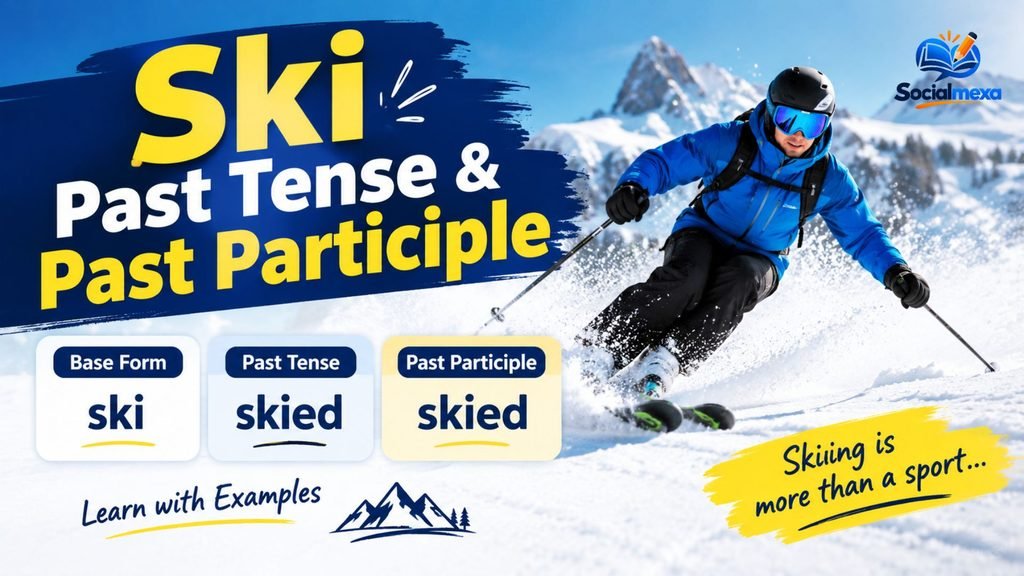
English verbs usually form their past tense by adding “-ed.” Simple enough, right? “Ski” follows that same pattern, but with one small twist that confuses a lot of writers.
Because “ski” already ends in the letter “i,” you don’t double that letter when adding “-ed.” You just tack the ending straight on.
- Present tense: ski
- Past tense: skied
- Past participle: skied
That’s it. No extra letters, no doubling, no drama.
Skied or Skiied – Quick Answer
If you only remember one thing from this article, remember this: always write “skied,” never “skiied.”
There’s no version of standard English, American or British, where “skiied” is accepted. It’s a common typo, not a regional variation.
Examples:
- Correct: We skied all weekend in Colorado.
- Incorrect: We skiied all weekend in Colorado.
- Correct: She has skied every winter since she was five.
- Incorrect: She has skiied every winter since she was five.
The Origin of Skied
The word “ski” itself comes from the Old Norse word “skíð,” which referred to a long piece of wood, essentially a wooden stick or plank used for moving across snow. Norwegian skiers carried that tradition forward, and by the late 1800s, “ski” had entered English as both a noun and a verb.
Once “ski” became a verb, English grammar rules simply took over. Regular verbs form their past tense with “-ed,” and “ski” plus “-ed” naturally produces “skied.” There was no committee debate or spelling reform involved. It’s just basic verb conjugation doing its job.
Skied or skiied past tense
To be direct: skied is the past tense. It’s also the past participle, which means it works the same way in both simple past sentences and perfect tense sentences.
- Simple past: I skied in the Alps last year.
- Present perfect: I have skied in the Alps before.
- Past perfect: By noon, we had already skied three runs.
“Skiied” never fits into any of these patterns correctly. If you see it in a sentence, it’s a typo waiting to be fixed.
| Don’t Miss These Articles |
| Bellies or Bellys? Discover the Correct Spelling Fast |
| Cosy or Cozy? Discover the Correct Spelling |
| Fiend or Feen: Discover the Correct Spelling & Meaning |
British English vs American English Spelling
Here’s some good news if you were bracing for a British-versus-American spelling battle: there isn’t one. Words like “color” and “colour” or “realize” and “realise” split along regional lines, but “skied” doesn’t.
Both American and British dictionaries agree on this one. “Skied” is standard everywhere English is spoken and written, whether you’re skiing the Rockies or the Alps.
Comparison Table
| Region | Correct Spelling | Accepted? |
| American English | Skied | Yes |
| British English | Skied | Yes |
| Australian English | Skied | Yes |
| Canadian English | Skied | Yes |
| “Skiied” (any region) | Skiied | No |
Skied or skiied synonym
Sometimes you just want a different word so your writing doesn’t feel repetitive. Since “skied” describes a completed action of skiing, a few natural alternatives include:
- Went skiing
- Skied down
- Hit the slopes
- Carved through snow
None of these are perfect one-word swaps, but they help you avoid saying “skied” five times in one paragraph. And to be clear, “skiied” is never a synonym. It’s simply an incorrect spelling of the same word.
Which Spelling Should You Use?

Use skied. Every time, in every sentence, in every type of writing.
There’s no context, casual or formal, spoken or written, where “skiied” becomes the right choice. If you’re texting a friend, writing a resume that mentions your ski instructor certification, or drafting a news article, stick with the one correct spelling.
Skied pronunciation
“Skied” is pronounced the same way it looks once you know the rule: skeed, rhyming with “seed” or “need.” It’s one syllable, quick and simple.
A lot of people mentally picture it as two syllables because of the double “i” in the misspelled version “skiied,” but that pronunciation doesn’t actually exist. Say it out loud: “I skied yesterday” sounds identical to “I skeed yesterday.”
Common Mistakes with Skied
Even confident writers slip up here. The most frequent mistakes look like this:
- Doubling the “i”: Writing “skiied” instead of “skied,” usually out of habit from other doubled-letter past tense verbs.
- Adding an extra syllable when speaking: Pronouncing it as “skee-eed” instead of the correct one-syllable “skeed.”
- Confusing “skis” with “skiis”: The plural noun for the equipment is “skis,” not “skiis.” Same doubling mistake, different word.
- Autocorrect confidence: Some phone keyboards don’t flag “skiied” as wrong, which makes people assume it must be correct.
Knowing these patterns makes it much easier to catch yourself before hitting send.
Skied in Everyday Examples
Seeing the word used in different real-world settings can help lock it into memory. Here’s how “skied” actually shows up across different types of writing.
Emails:
“Hi team, just a heads up that I’ll be out next week. I’ve skied this same resort before and the trail conditions in late January are usually excellent.”
News:
“Local officials confirmed that over 40,000 visitors skied the resort’s slopes during the holiday weekend, marking a record turnout for the season.”
Social Media:
“Just skied my first black diamond run and my legs are never forgiving me for this 😅❄️”
Formal Writing:
“The athlete has skied competitively for over a decade, earning multiple national titles in slalom and giant slalom events.”
Skied or skiied slang
You might be wondering if “skiied” has somehow become accepted slang, the way some informal spellings eventually work their way into casual usage. It hasn’t. Unlike words that intentionally break spelling rules for style (think “lite” or “thru”), “skiied” isn’t an intentional slang variation. It’s purely an error, and it doesn’t carry any special casual meaning or internet culture status. Slang usually adds flavor or personality. This one just adds confusion.
Skied – Google Trends & Usage Data

Search behavior tells an interesting story here. “Skied” consistently shows up as the standard search term in English-speaking regions, while “skiied” appears mainly as a misspelled search query, the kind Google quietly corrects with a “did you mean” suggestion.
This pattern matches how dictionaries and style guides treat the word too. Major sources like Merriam-Webster and Oxford list “skied” as the sole accepted past tense form, with no alternate spelling entry for “skiied” at all. When a misspelling doesn’t even earn a dictionary footnote, that’s a strong signal it never became legitimate usage, just a persistent typo.
Comparison Table: Skied or Skiied
| Feature | Skied | Skiied |
| Grammatically correct | Yes | No |
| Found in dictionaries | Yes | No |
| Accepted in formal writing | Yes | No |
| Common in casual typos | No | Yes |
| Pronunciation | One syllable (skeed) | Not applicable |
Skied or skiied in a sentence
Seeing correct and incorrect sentences side by side makes the rule stick faster than any explanation alone.
- Correct: My brother skied faster than everyone else on the team.
- Incorrect: My brother skiied faster than everyone else on the team.
- Correct: They have skied in three different countries this year.
- Incorrect: They have skiied in three different countries this year.
- Correct: I skied into a snowbank and laughed the whole way down.
- Incorrect: I skiied into a snowbank and laughed the whole way down.
Frequently Asked Questions
Is it skied or skiied?
It’s skied. This is the only correct spelling for the past tense and past participle of “ski” in standard English.
What is the past tense of ski?
The past tense of “ski” is skied. It’s formed by simply adding “-ed” to the base verb, without doubling the final “i.”
What does the word “skied” mean?
“Skied” means to have traveled or moved on skis in the past. It’s the completed action form of “to ski.”
Is it “skiis” or “skis”?
Neither is “skiis.” The correct plural noun for the equipment is skis, following the same no-doubling rule as “skied.”
Conclusion
Language rules can feel random sometimes, but this one is refreshingly simple. Skied is correct. Skiied is not, no matter how natural that extra “i” might feel while typing fast. The next time you’re recapping your weekend on the mountain, drafting a quick email, or writing something more formal, you can spell it with total confidence. One “i,” one syllable, zero confusion.

Emily Carter is an English language writer who creates simple guides on grammar, word meanings, spelling, slang, and everyday English. Her goal is to make confusing language topics clear, practical, and easy to understand.
3 thoughts on “Skied or Skiied? The Correct Spelling Explained”