

You write a sentence, pause, and wonder whether it is practise or practice. One letter changes, and your confidence vanishes. A slip in an email or essay can also make readers doubt the rest of your writing. The fix is simple, and this guide shows it step by step.
Quick Answer (Practise or Practice)
In British English, practice is the noun and practise is the verb. In American English, you use practice for both.
- British: “I need more practice.” / “I practise daily.”
- American: “I need more practice.” / “I practice daily.”
If you write for a US audience, you can skip the S version entirely. If you write for the UK, Australia, or India, keep reading.
Practice Meaning
Start with the word you will use most. Practice names an action you repeat to improve, or the way something is usually done. It also names a professional business.
A pianist has practice every evening. A company has a standard practice for handling refunds. A dentist runs a practice on Main Street. The word stays the same in every English variety when it works as a noun. Nobody argues about that one, which makes it the friendly half of the pair.
| Related Articles You’ll Love |
| Pricey or Pricy? Discover the Correct Spelling Fast |
| Gage or Gauge? Discover the Correct Spelling Fast |
| Followup or Follow Up? Get It Right Every Time |
Meaning and Definition of Each Word (Practise or Practice)
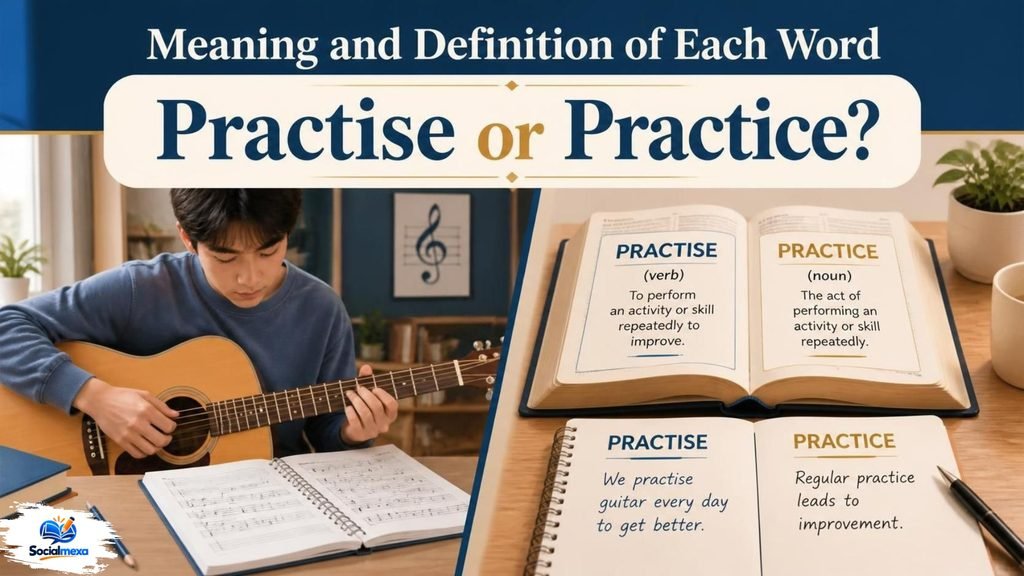
Now that you know the quick rule, here is what each word means and how it behaves.
1. Practice (Noun)
As a noun, practice has three common meanings:
- Repeated training: “Soccer practice starts at five.”
- Habit or custom: “Tipping is common practice in the US.”
- A professional business: “She opened a veterinary practice.”
You can often test a noun by putting the, a, or some in front of it. “Some practice” works, so practice is a noun here.
2. Practise (Verb)
As a verb in British English, practise means to do something repeatedly to improve, or to work in a profession.
- “He practises the guitar after school.”
- “She practises law in Manchester.”
A verb describes an action, so try a pronoun test. “I practise,” “you practise,” and “they practise” all sound natural. Verbs also change form. You get practised and practising, which matter in the sections ahead.
Practise or Practice Examples
Seeing both words side by side makes the pattern easier to spot.
- Practice (noun): “Choir practice ran late again.”
- Practise (verb): “We practise our harmonies on Thursdays.”
- Practice (noun): “It is good practice to back up your files.”
- Practise (verb): “Please practise safe habits online.”
Notice that the noun answers “what?” and the verb answers “what is happening?” In the first example, practice is a thing. In the second, practise is an action.
Key Differences Between the Words
Here are the differences that matter most:
- Part of speech: Practice is a noun. Practise is a verb in British English.
- Spelling: Practice uses a C in the last syllable. Practise uses an S.
- Region: American English drops the split and uses practice for everything.
- Related forms: Practised and practising belong only to the verb. The noun has no such forms.
If you remember just one line, make it this: British English tells nouns and verbs apart by spelling, and American English does not.
Practise or Practice Grammar
Grammar explains why the spelling splits in the first place. English has several word pairs where British writers use C for the noun and S for the verb. The pattern has a clear logic once you see it.
Take a sentence: “The doctor will practise (verb) at a new practice (noun).” Both words appear, and each fits its role. The verb is the action, and the noun is the place.
Verb forms follow regular rules:
- Present: I practise
- Past: I practised
- Continuous: I am practising
The past and continuous forms keep the S. Writers who stumble often forget that and slip a C into practised. Keep the S, and the sentence works.
Comparison Table
Here is a quick view of both words in each major English variety.
| Feature | Practice | Practise |
| British English | Noun | Verb |
| American English | Noun and verb | Rare, seen as a variant |
| Australian English | Noun | Verb |
| Canadian English | Noun | Verb (often preferred) |
| Example | “Daily practice helps.” | “Practise daily.” |
Notice how the table shows one clear split. The US stands alone in merging the two, and most other English speaking regions keep them apart.
Examples in Sentences
Sentences stick in your memory better than rules, so here are plenty.
Using Practice (Noun)
- “Her practice paid off when she won the spelling bee.”
- “Bad practice can ruin a good recipe.”
- “The law firm has a busy practice.”
- “Practice makes the long drive to the gym feel worth it.”
Using Practise (Verb)
- “I practise my speech in the shower.”
- “They practised for hours before the show.”
- “He is practising his French before the trip.”
- “Practise patience, because the kettle takes forever.”
Try covering the bold words in your head. If a noun or a verb would fit, you will know which spelling to choose.
Practise or Practice Makes Perfect
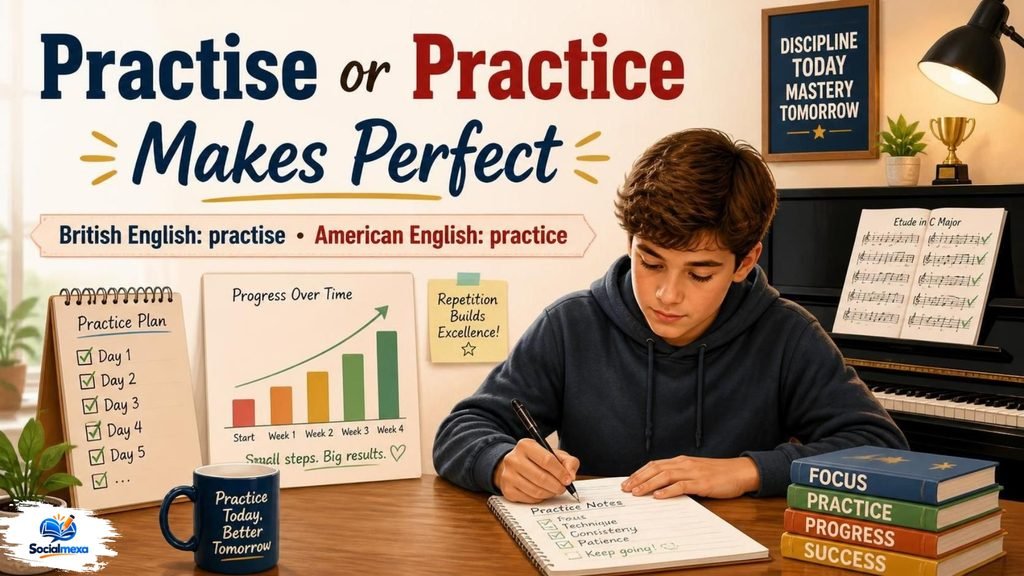
This famous saying causes more confusion than any other phrase. Which spelling is correct? Practice makes perfect is the standard form in both Britain and America.
Here the word works as a noun, since practice is the thing that creates perfection. Because it is a noun, even a British writer uses the C. Some people write “practise makes perfect” because the idea feels like an action. That version is incorrect in formal British writing.
The saying has been around for a long time, and it still holds up. Repetition builds skill, whether you learn piano or spelling rules.
Practise or Practice Worksheet
Test yourself with this short exercise. Use British rules and choose the right spelling. Answers are below.
- I need to ____ my presentation tonight.
- Football ____ starts at six.
- She has a successful medical ____.
- They ____ yoga every morning.
- It is bad ____ to skip a safety check.
Answers:
- practise (verb)
- practice (noun)
- practice (noun)
- practise (verb)
- practice (noun)
Got four or five right? You have the rule down. Missed a few? The next sections help.
Common Mistakes
Even confident writers trip on this pair. Watch for these errors.
- Using practice as a verb in British writing: “I practice every day” is American usage. British readers expect practise.
- Dropping the S in practised: “She practiced the speech” is American. British writers write practised.
- Mixing styles in one document: Pick one variety and stay with it. Switching halfway looks sloppy.
- Writing practise as a noun: “I need more practise” is wrong in every variety.
The last mistake is the most serious, since no English dialect accepts it. Fix that one first.
Tips to Remember the Difference
You do not need to memorize a rulebook. Use these tricks instead.
- The alphabet trick: C comes before S. The noun comes before the verb in many sentences, and C goes with the noun.
- The advice trick: Advice is a noun and advise is a verb. Practice and practise follow the same pattern.
- The ice trick: Practice has the letters ice, and ice is a noun you can hold. (Please do not hold it too long.)
- The swap test: Replace the word with advice or advice. If advice fits, use practise. If advice fits, use practice.
The swap test works almost every time. Pick one trick that feels natural and use it.
Doctors Practise or Practice
Medical writing creates the most searches for this topic, so here is the clear answer.
In British English, a doctor practises medicine at a medical practice. Both words appear in one sentence, and each fits its role. In American English, a doctor practices medicine at a medical practice.
Lawyers, dentists, and therapists follow the same pattern. A lawyer in London practises law, and a lawyer in Chicago practices law. The profession does not change the rule. Only the region does.
When to Use Each Word
Use this short guide to decide fast.
- Writing for a US audience? Use practice for everything.
- Writing for a UK, Australian, Indian, or Canadian audience? Use practice as a noun and practise as a verb.
- Writing for a global audience? Choose one standard and apply it everywhere. Consistency matters more than which one you pick.
Not sure who will read your work? Check the style guide of the publication, school, or company first. Many organizations state their preference in plain terms.
Best Practise or Practice

“Best practice” is a common business phrase, and it surprises people. The correct form is best practice, with a C, in both British and American English.
Here practice is a noun that means an approved method. “Following best practice reduces errors.” Writing “best practise” looks wrong to editors on both sides of the Atlantic.
You will see this phrase in healthcare, software, teaching, and law. If you learn only one fixed expression from this guide, make it this one.
Grammar Rules
Here is the whole system in one place:
- Noun in any variety: practice.
- Verb in British English: practise.
- Verb in American English: practice.
- Past tense, British: practised.
- Past tense, American: practiced.
- Continuous, British: practising.
- Continuous, American: practicing.
- Adjective: practised (British) or practiced (American), as in “a practised eye.”
The adjective form is easy to miss. A practised chef is an experienced chef, and the same logic applies.
Synonyms or Related Words
Sometimes the best fix is a different word. These alternatives avoid the spelling question completely.
- For the verb: rehearse, train, drill, rehearse, polish, repeat
- For the noun (training): rehearsal, drill, training, exercise, preparation
- For the noun (custom): habit, routine, tradition, method, procedure
- For the noun (business): firm, clinic, office, business
Use these when a sentence feels clunky. “Rehearse your speech” sounds fresher than “practise your speech,” and no spelling debate follows.
Practise or Practice UK
UK readers often ask whether the rule is strict. In formal writing, it is. British schools, newspapers, and publishers all separate nouns and verbs.
You will still see “practice” used as a verb in casual UK writing, because American spelling spreads through the internet. Even so, careful British writers keep the split. If your readers include teachers, editors, or professionals, follow the traditional rule.
Spelling tools can mislead you here. A spellchecker set to US English will mark practise as wrong, and one set to UK English will mark “I practice daily” as wrong. Set your language to match your readers.
FAQs About Practise or Practice
When should I use practise and practice?
Use practice for the noun in all English varieties. Use practise as the verb in British English. In American English, use practice for both.
What does “practise” mean?
Practise means to repeat an activity to improve, or to work in a profession. “She practises the violin” and “He practises as a surgeon” are both correct British uses.
Does a doctor practice or practise?
In Britain, a doctor practises medicine. In America, a doctor practices medicine. In both countries, the clinic is called a practice.
What is a practice example?
A practice example is a sentence or situation that shows the word in use. “Basketball practice ended at six” shows practice as training. “The dental practice opened in May” shows it as a business.
Conclusion (Practise or Practice)
The rule is short. Practice is the noun everywhere. Practise is the British verb, and Americans use practice for that too. Pick the style your readers expect, apply it consistently, and use the advice and advise trick when in doubt.
Now that you know the rule, try it in your next email. A little practice goes a long way, and it will make your writing look sharper. Just remember to practise it, or practice it, depending on where you live.

Emily Carter is an English language writer who creates simple guides on grammar, word meanings, spelling, slang, and everyday English. Her goal is to make confusing language topics clear, practical, and easy to understand.
1 thought on “Practise or Practice? Discover the Correct Usage”