


You are writing about a family event and you stop mid-sentence. Should it say the baby was baptised or baptized? Both spellings look right, and your spell checker may flag one of them depending on its language setting. Many writers worry that one version is simply a mistake.
This guide answers the question of Baptised or Baptized in plain terms. You will learn what each spelling means, where each one is used, and how to choose the right one for your readers. We also cover verb forms, pronunciation, common mistakes, and easy ways to remember the difference, so you can write with confidence in emails, essays, and church bulletins.
Quick Answer
Both spellings are correct. “Baptized” is the standard spelling in American English, and “baptised” is the common spelling in British English. The meaning is exactly the same.
If your readers are in the United States, use “baptized.” If your readers are in the UK, Australia, or most Commonwealth countries, “baptised” is usually the better fit. Pick one spelling and keep it throughout your text.
Baptised or Baptized Catholic
Writers often ask which spelling to use in a Catholic context. The answer depends on location, not on religion. A Catholic parish in the United States writes “baptized,” while a parish in England or Ireland usually writes “baptised.”
Catholic teaching treats baptism as the first sacrament, and the word is spelled the same in both regions. Only the verb and its related forms change. So you might read “She was baptized at St. Mary’s” in a US bulletin and “She was baptised at St. Mary’s” in a UK one.
Meaning and Definition of Each Word (Baptised or Baptized)

Both words come from the Greek baptizein, which meant to dip or immerse. In English, the baptized definition and the baptised definition are identical: to perform the Christian ceremony of baptism, or to be admitted into the Christian faith through that ceremony. Both words can also be used figuratively, which we cover later.
Baptised (British English)
“Baptised” follows the British habit of spelling many verbs with -ise. It is the usual form in UK newspapers, church publications, and school materials. You will also see it in Australia, New Zealand, and Ireland.
| Articles You Shouldn’t Miss |
| Muah or Mwah? Discover the Correct Spelling Fast |
| Devine or Divine? Discover the Correct Spelling Fast |
| Optimisation or Optimization? Discover the Correct Spelling |
Baptized (American English)
“Baptized” uses the -ize ending, which is standard in the United States and Canada. This ending is also closer to the Greek origin of the word. Some British publishers, including Oxford University Press, also prefer -ize, so you may see “baptized” in UK academic writing too.
Key Differences Between the Words
The only real difference is the letter before the final -ed. Meaning, grammar, and pronunciation do not change. This is one of many spelling differences in English between the UK and the US.
The difference carries through every form of the verb:
- baptise / baptize (base form)
- baptises / baptizes (third person singular)
- baptising / baptizing (present participle)
- baptised / baptized (past tense and past participle)
- baptiser / baptizer (a person who baptizes)
Baptised in Spanish
The Spanish verb for this word is bautizar. “Baptised” or “baptized” translates as bautizado for a male and bautizada for a female. For example, “He was baptized as a baby” becomes “Fue bautizado de bebé.”
Spanish has only one spelling, so the British and American split does not apply. The related noun is bautismo, which matches the English word “baptism.”
Baptised or Baptized Pronunciation
Both words sound the same. They are pronounced “bap-TIZE” with the stress on the second syllable, and the ending rhymes with “size.” The -ised and -ized endings make the same sound.
Accents can shift the vowel slightly, but the spelling does not change how the word is said. If you are reading aloud, you do not need to think about which version is on the page.
Comparison Table
| Feature | Baptised | Baptized |
| Region | UK, Australia, New Zealand, Ireland | US, Canada |
| Spelling style | British English | American English |
| Meaning | Same | Same |
| Present participle | Baptising | Baptizing |
| Third person | Baptises | Baptizes |
| Person who baptizes | Baptiser | Baptizer |
| Noun form | Baptism | Baptism |
| Pronunciation | bap-TIZE | bap-TIZE |
Examples in Sentences
Seeing the words in context makes the rule easier to remember. Each example below keeps one spelling style from start to finish.
Using “Baptised”
- She was baptised at the village church last spring.
- The vicar is baptising three children on Sunday.
- My cousin was baptised in water at a river service.
- The minister baptises new members each Easter.
Using “Baptized”
- She was baptized at the church last spring.
- The pastor is baptizing three children on Sunday.
- My cousin was baptized in water at a river service.
- The minister baptizes new members each Easter.
Common Mistakes
Most errors with this word are about consistency, not about right and wrong. Here are the four mistakes that appear most often.
1. Mixing British and American English
Writing “baptised” next to words like “color” or “center” creates a mismatch. If you use British spelling for one word, use it for the rest. Likewise, American spelling should go with “color,” “center,” and “organize.”
2. Using Both Spellings in One Text
A single article, email, or document should use one spelling only. Readers notice when “baptized” appears in one paragraph and “baptised” in the next. Run a quick search before you publish.
3. Thinking They Have Different Meanings
Some people assume one spelling is religious and the other is general. That is not true. Both spellings describe the same ceremony and the same figurative uses.
4. Wrong Verb Form
Writers sometimes forget that the ending changes with tense. Use “baptise” or “baptize” for the base form, not “baptised” or “baptized.” For example, write “They plan to baptize the baby,” not “They plan to baptized the baby.”
Baptised UK Spelling
In the UK, “baptised” is the most common choice in everyday writing. News outlets, church newsletters, and school websites generally use it. The same rule applies to many other verbs, such as organise, realise, and recognise.
The word “baptism” does not change, because the -ism ending is the same in both regions. Only verb forms ending in -ise or -ize follow the regional pattern. Not every word with this ending follows it, though. “Advise,” “revise,” and “surprise” use -ise in both countries.
Tips to Remember the Difference
A few simple memory aids can help you choose quickly.
- Think “Z for the USA.” The letter Z appears in “baptized” and in “America’s” preferred -ize pattern.
- Match the rest of your text. If you write “colour” and “favourite,” use “baptised.”
- Check your spell checker language. Set it to English (US) or English (UK) before you proofread.
- When in doubt, follow your audience. Write for where your readers live.
Baptised in Fear
You may see phrases like “baptised in fear” or “baptized by fire.” These are figurative uses. They describe a person who is introduced to something through an intense, difficult first experience.
For example, a new nurse might be “baptized by fire” on a busy first night shift. The same spelling rules apply, so use “baptised” in British English and “baptized” in American English. Because the phrase is not about a religious ceremony, it often appears in news writing and fiction.
When to Use Each Word (Baptised or Baptized)
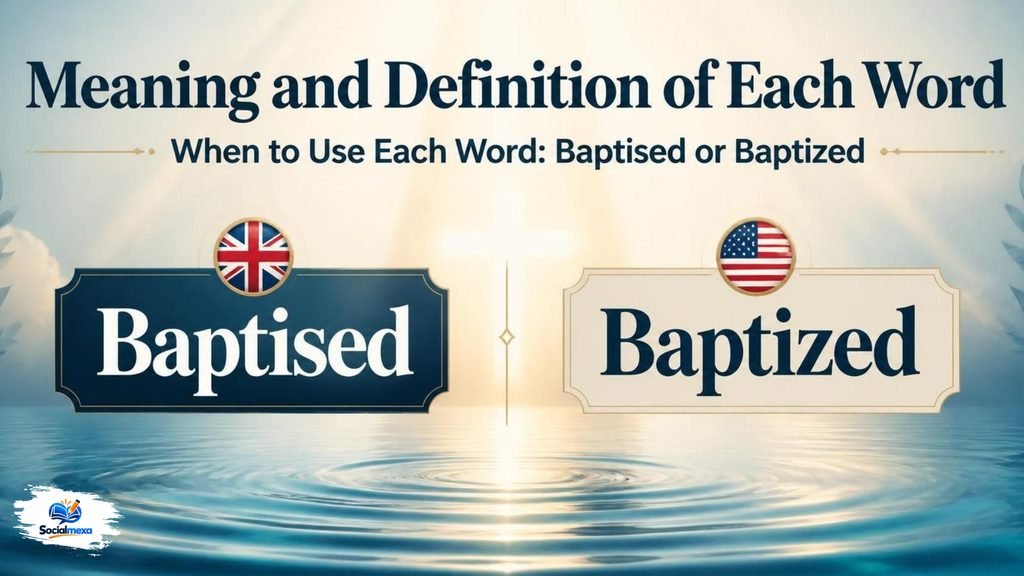
Your choice should depend on your audience and your style guide. The two lists below make it simple.
Use “Baptised” When:
- Your readers are mainly in the UK, Australia, New Zealand, or Ireland.
- You are following a British style guide.
- Your document already uses spellings like “colour” and “organise.”
Use “Baptized” When:
- Your readers are mainly in the US or Canada.
- You are following an American style guide such as AP or Chicago.
- Your document already uses spellings like “color” and “organize.”
Baptised Catholic
When you describe someone as “baptised Catholic,” you mean they received baptism in the Catholic Church. The phrase is common on forms, in parish records, and in family histories. In the US, the same phrase is written “baptized Catholic.”
Catholic baptism is usually done with water and the words of the Trinitarian formula. Many families baptize infants, while adults who join the Church are often baptized at the Easter Vigil. The spelling follows regional rules in every case.
Grammar Rules
Baptize is a regular verb, so the past tense and past participle are formed by adding -d. That gives “baptized” or “baptised.” It is also a transitive verb, which means it needs an object: someone baptizes a person.
Words ending in -ise or -ize follow a similar pattern across English. In American English, the ending is almost always -ize. In British English, -ise is more common, but -ize is also accepted in some academic and publisher styles. This is why “organise vs organize”, “realise vs realize”, and “recognise vs recognize” work the same way as baptise vs baptize.
Synonyms or Related Words
Several words are related to baptize, though they are not always exact matches.
- Christen: often used for baptizing a baby and giving the child a name.
- Immerse: to dip fully into water, which reflects the original Greek meaning.
- Initiate: to formally admit someone into a group or faith.
- Consecrate: to make something sacred.
- Baptismal: an adjective, as in “baptismal font” or “baptismal certificate.”
The difference between christening vs baptism is mostly about use. Baptism is the religious ceremony, while christening is often used in everyday speech for the same event, especially in the UK.
Baptised Christian
“Baptised Christian” refers to a person who has received baptism as part of Christian practice. Different churches have different customs. Some baptize infants, while others baptize only believers who are old enough to make the decision themselves.
The method also varies. Some churches pour or sprinkle water, and others fully immerse the person. Whatever the tradition, the spelling you choose still depends on your audience and not on the denomination.
Frequently Asked Questions
Is it spelled baptised or baptized?
Both are correct. Use “baptized” in American English and “baptised” in British English, and keep the same spelling throughout your writing.
What does it mean to be baptised?
It means a person has gone through the Christian ceremony of baptism, usually with water, as a sign of cleansing and entry into the faith.
What is the difference between “baptized” and “baptised”?
There is no difference in meaning or sound. “Baptized” is the American spelling, while “baptised” is the British spelling.
Are Muslims baptised?
No. Baptism is a Christian practice, and Islam has no equivalent ceremony. Converts to Islam recite the declaration of faith instead.
Conclusion
“Baptised” and “baptized” mean the same thing and sound the same. The only difference is regional spelling: baptized for American English and baptised for British English. The same pattern applies to the verb forms, so you will write baptizing, baptizes, and baptizer in the US, and baptising, baptises, and baptiser in the UK.
The best rule is simple: choose the spelling that matches your audience and stay consistent. If you are ever unsure about Baptised or Baptized, check your other spellings, set your spell checker to the right language, and follow your style guide. A small check like this keeps your writing clear and professional.

Emily Carter is an English language writer who creates simple guides on grammar, word meanings, spelling, slang, and everyday English. Her goal is to make confusing language topics clear, practical, and easy to understand.