


Have you ever written “a devine dessert” and then stopped to wonder if the spelling was right? It is a common worry, because the two words sound nearly the same and only one letter sets them apart. Many writers type by ear, and spellcheck does not always catch the problem, since “Devine” is a real surname. A wrong choice can make a caption, email, or school paper look careless.
So, Devine or Divine: which one is correct? This article gives you a clear answer, explains what each word means, and shows where each one belongs. You will also see where the words come from, which mistakes to avoid, and a simple trick to remember the right spelling every time.
Devine
“Devine” is a surname, most often linked to Irish families. It is a proper noun, so it always begins with a capital letter. It is not the standard spelling of the everyday English word.
Divine
“Divine” is the everyday English word. It is mainly an adjective that describes something related to God or something wonderful. It is pronounced dih-VYNE.
Devine or Divine Meaning
The two spellings look alike, but they do different jobs. “Divine” is a common word found in any dictionary. “Devine” is a name used for people, families, and a few places.
If you are describing a sunset, a meal, a blessing, or a gift from God, the word you want is “divine”. If you are writing about a person named Devine, you keep the name as it is.
| Related Articles You’ll Love |
| 23th or 23rd? Discover the Correct Spelling Fast |
| Canceled or Cancelled? Discover the Correct Spelling Fast |
| Hidding or Hiding? Discover the Correct Spelling Fast |
Devine or Divine: Quick Answer

The correct spelling for the English word is divine. “Devine” is not a standard English word. It appears only as a surname or as a typing mistake.
Examples:
- Correct: The soup tasted divine.
- Incorrect: The soup tasted devine.
- Correct: Mr. Devine will join us at noon.
Simple Rule:
Use “divine” for the word and “Devine” only for the name.
Divine Meaning
The definition of divine depends on how the word is used. As an adjective, it means coming from or relating to God or a god. It can also mean extremely good or lovely, as in “a divine view.”
“Divine” can also be a verb. As a verb, it means to find something out by intuition or guesswork, such as “She divined his plan from his tone.” Less often, it is a noun that refers to a member of the clergy or a person who studies theology.
The Origin of Devine or Divine
The history of each word explains why they look so similar. They are not related in meaning, but they landed close together in spelling and sound.
Origin of “Divine”
“Divine” comes from the Latin word divinus, which means “of a god.” It reached English through Old French, and it has been used in English for centuries. Its root links it to ideas of gods, worship, and holy things.
Examples:
- The choir sang during the divine service.
- Her cooking is simply divine.
- Many people seek divine guidance in hard times.
Origin of “Devine”
“Devine” is generally treated as an anglicized form of an Irish Gaelic surname. It spread through Ireland and later to the United States, Canada, and Australia. Because it grew out of a family name, it has no link to the Latin root of “divine.”
Devine or Divine: Meaning Explained
Seeing the two words side by side makes the difference clear. One carries a dictionary meaning. The other identifies a person or family.
What Does “Divine” Mean?
Divine meaning can be grouped into a few ideas: holy, heavenly, godlike, and sacred. It can also mean wonderful when used as praise. This is the meaning of divine in English that most readers need.
Examples:
- The church felt peaceful and sacred, almost divine.
- That chocolate cake was divine.
- The king believed he ruled by divine right.
What Does “Devine” Mean?
“Devine” has no dictionary meaning as an English word. It only identifies someone, such as a person with that last name. If you see it in a sentence meant to describe something lovely or holy, it is a spelling error.
Examples:
- Sarah Devine started the book club.
- The Devine family moved to Ohio last year.
- Incorrect: What a devine idea!
Devine or Divine Synonyms
Only “divine” has synonyms, because “Devine” is a name. Here are common divine synonyms and where they fit:
- Holy: a holy place, a holy book
- Heavenly: a heavenly voice, a heavenly dessert
- Sacred: a sacred ritual, a sacred space
- Godlike: a godlike talent
- Sublime: a sublime performance
- Superb: a superb meal
Pick the synonym that matches your tone. “Sacred” and “holy” fit religious writing, while “superb” and “heavenly” fit casual praise.
British English vs American English Usage (Devine or Divine)
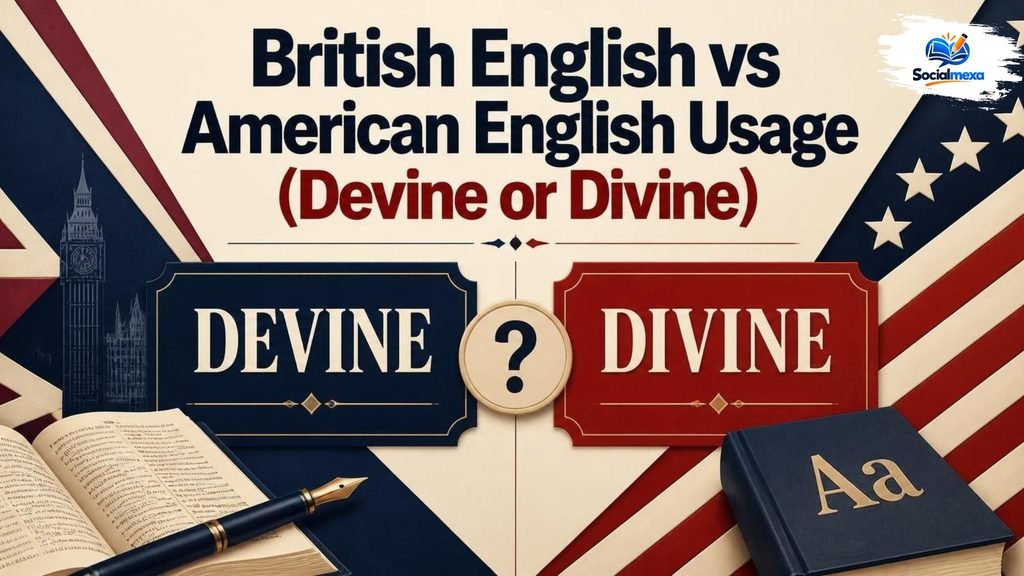
The spelling does not change between British and American English. Both use “divine” for the word, and both use “Devine” for the surname. This is not like “color” and “colour,” where the two varieties differ.
If you see “devine” in either country, it is a mistake or a name. The British vs American spelling of divine question has a simple answer: they are the same.
Comparison Table
| Feature | American English | British English |
| Spelling of the word | divine | divine |
| Spelling of the surname | Devine | Devine |
| Pronunciation | dih-VYNE | dih-VYNE |
| Is “devine” a standard word? | No | No |
Divine Meaning French
In French, the word is divin for masculine nouns and divine for feminine nouns. It carries the same ideas of godliness and beauty. For example, une soirée divine means “a divine evening.”
This is helpful for English learners, because the French spelling matches the English spelling. If you know the French form, you can remember that English uses an “i” in the first syllable too.
Which Spelling Should You Use?
Most of the time, the answer is “divine.” The name spelling is limited to specific cases. A quick check of your sentence will tell you which one belongs.
Use “Divine” When Talking About:
- God, gods, or holy things
- Something excellent or beautiful
- Guessing or sensing something through intuition
- Common phrases like divine power or divine love
Use “Devine” Only When:
- You are writing a person’s last name
- You are naming a family, company, or place that uses the name
- You are copying a name exactly as written
Simple Rule:
If it describes a thing, use “divine.” If it names a person, use “Devine.”
Common Mistakes with Devine or Divine
These errors appear often in emails, posts, and essays. Knowing them helps you spot problems before you hit send.
Mistake 1
Writing “devine” as a compliment. Example: “Your garden looks devine.” The correct sentence is “Your garden looks divine.”
Mistake 2
Lowercasing the surname. Writing “mr. devine” is wrong. The correct form is “Mr. Devine.”
Mistake 3
Trusting spellcheck. Because “Devine” is a valid name, some tools do not flag it. Always check the meaning yourself.
Mistake 4
Mixing up the verb and the adjective. “She divined the answer” uses the verb, and “a divine answer” uses the adjective. Both use the “i” spelling.
Is Devine a Word
“Devine” is not a word in standard English dictionaries. It is a surname and, in most everyday writing, a misspelling of “divine.” Anyone searching for an adjective that means holy or wonderful should use “divine.”
The only safe time to write “Devine” is when you are naming a person or a group that uses that spelling.
Divine in Everyday Examples
You will meet this word in many parts of daily life. Here is how it appears in different settings.
Compliments
- That pasta was divine.
- You look divine in that coat.
Religion
- Many believers describe prayer as a search for divine help.
- The teacher spoke about divine blessing and gratitude.
Social Media
- Sunset vibes, absolutely divine.
- This playlist is pure divine love for good music.
Literature
- Writers often use divine beauty to describe a perfect scene.
- Poets may refer to divine wisdom as a source of truth.
Devine or Divine Bible
The word “divine” appears in many English Bible translations. It is used when speaking of God, God’s nature, or God’s power. “Devine” does not appear as a word in these texts.
Readers who see “devine” in a religious post are almost always looking at a typo. The proper spelling is “divine” in any Bible discussion.
Devine or Divine Bible Verse
A well-known example is 2 Peter 1:3 to 1:4 in the King James Version. It speaks of “his divine power” and being partakers of “the divine nature.” Both use the spelling “divine.”
When quoting a verse, copy the spelling from your translation. If you see “devine” in a quote, check the source, because it is likely a mistake.
Devine or Divine: Google Trends and Usage Data
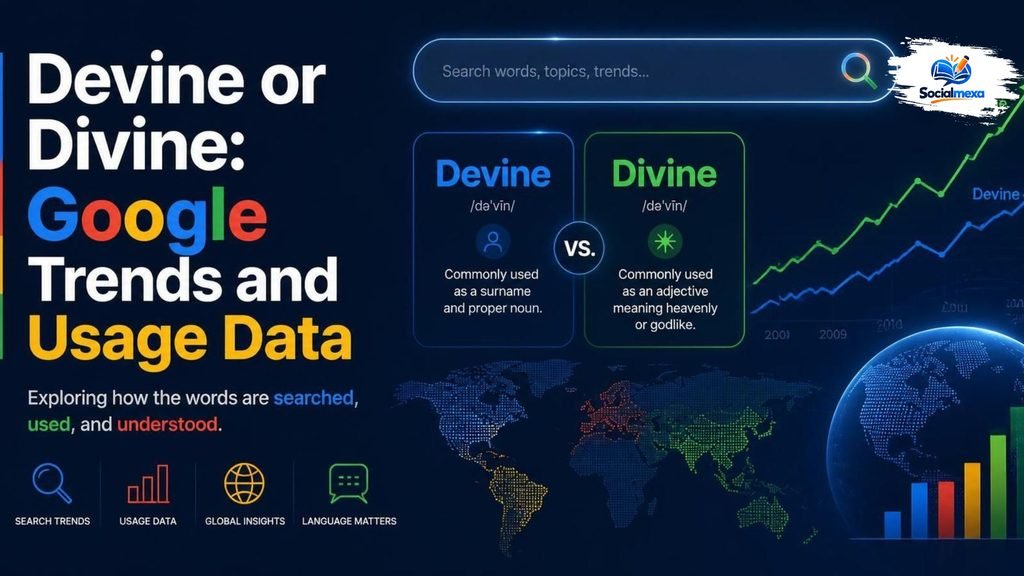
Search tools suggest that readers often type both spellings, which shows how common the confusion is. People usually search for “divine” when they want the meaning, and “devine” when they are unsure of the spelling or looking for a name.
Key Insight:
You can check current patterns yourself with Google Trends. Compare “devine” and “divine” over time and by region to see how often each is searched.
Comparison Table: Devine or Divine
| Feature | Divine | Devine |
| Type | Adjective, verb, noun | Proper noun (surname) |
| Capitalized? | Only at the start of a sentence | Always |
| Meaning | Holy, godlike, wonderful | Identifies a person or family |
| Found in dictionaries? | Yes | No, except as a name |
| Example | The view was divine. | Ms. Devine called earlier. |
Divine in Figurative English
Many people use “divine” in a figurative way. In these cases, the word does not talk about God directly. It praises something as lovely, perfect, or almost too good to be true.
Examples:
- The bakery’s bread was divine.
- It was a divine stroke of luck.
- Their garden felt like a divine escape.
Divine in Religious Writing
In religious writing, “divine” often points to God or to spiritual matters. Phrases such as divine intervention, divine power, and divine guidance are common. They describe help or action believed to come from God.
Writers should stay consistent with the spelling in every such phrase. A single “devine” can distract the reader and weaken an otherwise careful piece.
Why People Spell It “Devine”
Most mistakes come from sound. In fast speech, the first vowel in “divine” is soft, so it can sound like “duh” or “deh.” Writers may then choose “e,” as in words like “devote” and “develop.”
Exposure to the surname also plays a part. Seeing “Devine” on name tags, movie credits, or news stories makes the spelling look familiar, even when it is wrong for the word.
Devine as a Name
“Devine” is a recognized last name, and it is also used as a first name or brand name in some places. It should be capitalized and spelled the way the person or business writes it. Using it as a general adjective is not correct.
Examples:
- Author Maria Devine signed copies on Friday.
- The Devine family runs a local hardware store.
- Please send the form to Dr. Devine.
Devine Name Meaning
The Devine surname meaning is tied to Irish roots. It is usually described as an anglicized form of a Gaelic family name. Name records and genealogy sites can give more detail for a specific family line.
The key point for writers is that Devine as a last name has nothing to do with the English word “divine.” The similarity is a coincidence of sound.
Simple Trick to Remember the Difference
A short memory aid can help you pick the right spelling in seconds. Tie the word to an image you already know.
Easy Memory Rule
“Divine” rhymes with “wine,” and both have an “i” before “ne.” Think “divine wine,” and you will keep the “i” in place.
Quick Reminder
- Describing something? Use divine.
- Naming a person? Use Devine.
- Not sure? Check if the word means holy, godlike, or wonderful. If yes, use “divine.”
FAQs About Devine or Divine
Is devine a real word?
No. “Devine” is not a standard English word. It is a surname, or a misspelling of “divine.”
Who is called divine?
God, gods, and holy figures are called divine. People also use the word for anything wonderful, like a divine meal.
What does devine mean?
“Devine” has no dictionary meaning. It is a last name, and in casual writing it is often a mistaken spelling of “divine.”
Who is a devine?
A “Devine” is a person with that surname. A “divine,” with an “i,” is also an old term for a clergy member.
Conclusion (Devine or Divine)
The answer to the question is simple. The English word is spelled “divine,” and it means holy, godlike, or wonderful. “Devine” is a surname and should be used only for people or families with that name. The words sound alike, but their jobs are completely different.
Next time you are unsure about Devine or Divine, ask whether you are describing something or naming someone. If you are describing, write “divine.” If you are naming, write “Devine.” Keep the “divine wine” trick in mind, and your writing will stay clear and correct.

Emily Carter is an English language writer who creates simple guides on grammar, word meanings, spelling, slang, and everyday English. Her goal is to make confusing language topics clear, practical, and easy to understand.
3 thoughts on “Devine or Divine? Discover the Correct Spelling Fast”