

Ever typed “openning” in an email and then stared at it wondering if it looked wrong? You are not alone. This tiny extra “n” trips up thousands of writers every single day, even people who write for a living. The good news is that the fix takes about thirty seconds to learn and you will never make this mistake again.
Opening or Openning – Quick Answer

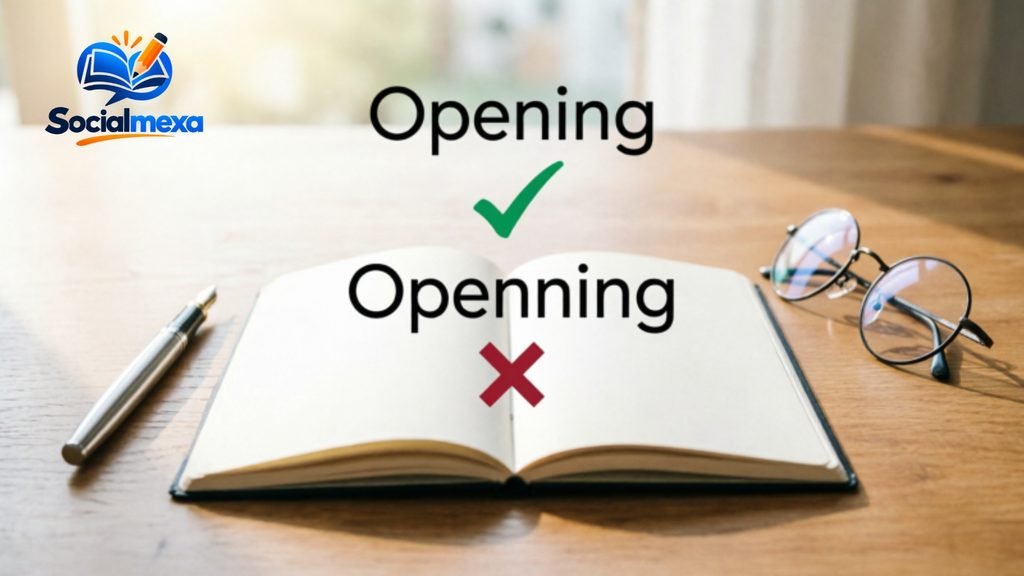
The correct spelling is opening. There is no double “n” anywhere in this word. “Openning” is simply a common typing error, not an alternate spelling, not a British variation, and not something you will find in any dictionary.
Meaning
“Opening” refers to the act of making something accessible, the beginning of an event, or a gap or hole. It can work as a noun, a verb, or an adjective depending on the sentence.
Examples
- The store’s grand opening starts at 9 AM.
- She is opening the door for her grandmother.
- There is a job opening in the marketing department.
Quick Comparison
| Spelling | Correct? | Notes |
|---|---|---|
| Opening | Yes | Standard spelling in all English dialects |
| Openning | No | Common misspelling, never correct |
Opening or Openning Meaning
At its core, “opening” describes something that is starting, becoming available, or being made accessible. Whether you are talking about a store, a conversation, a wound, or a chess game, the word carries the same basic idea of a beginning or an entry point.
| Keep Reading These Articles |
| Skis or Skiis? Discover the Correct Spelling & Meaning |
| Proove or Prove? Find the Correct Spelling Fast |
| Salvadoran or Salvadorian? The Correct Word Explained |
What Does “Opening” Mean?
Think of “opening” as a doorway word. It points to three main ideas.
First, it can mean the start of something, like the opening of a movie or a ceremony. Second, it can mean a gap or space, like an opening in a fence. Third, it can describe an available position, like a job opening. One word, three doors, all connected by the same root idea of access.
Opening or Openning Quiz
Test yourself quickly. Which sentence is spelled correctly?
- “The opening ceremony was beautiful.”
- “The openning ceremony was beautiful.”
If you picked the first one, you already understand the rule better than a surprising number of native speakers. Sentence two is wrong every time, no exceptions.
Is “Openning” a Correct Word?
No. “Openning” does not exist in Merriam Webster, Oxford, Cambridge, or any other reputable dictionary. It is not slang, not a regional spelling, and not accepted in academic or professional writing. If a spell checker lets it slide, that is a bug, not a green light.
Opening or Openning Grammar
Grammatically, “opening” follows the standard rule for adding “ing” to a verb. The base verb is “open,” and English spelling rules tell us exactly how to handle the ending when we add a suffix. Getting this right is less about memorizing a random exception and more about understanding one simple pattern, which we will break down next.
The Origin of Opening
The word “open” traces back to Old English “openian,” which itself connects to Proto Germanic roots shared with Dutch and German. Across centuries of language shift, English speakers added the “ing” suffix using consistent spelling logic, the same logic still taught in grammar schools today.
Why “Opening” (Not Openning)?
The final consonant in “open” is “n,” but the syllable before it is unstressed. Unstressed final syllables do not trigger consonant doubling in English, which is exactly why we write “opening” with a single “n” and not two.
English Spelling Rule Behind Opening
Here is the rule in plain terms. When a verb ends in a single consonant preceded by a single vowel, you double that consonant before adding “ing,” but only if the final syllable is stressed. Say “open” out loud. The stress falls on the first syllable, “OH-pen,” not the second. Because the last syllable is unstressed, the “n” stays single.
Why the Final “n” Is Not Doubled
Compare “open” to “stop.” In “stop,” the single syllable is stressed, so it becomes “stopping” with a doubled “p.” In “open,” the second syllable has no stress, so the rule that doubles consonants simply does not apply. This is the exact same reason “happen” becomes “happening” and not “happenning.”
Common Verb + -ing Spelling Patterns
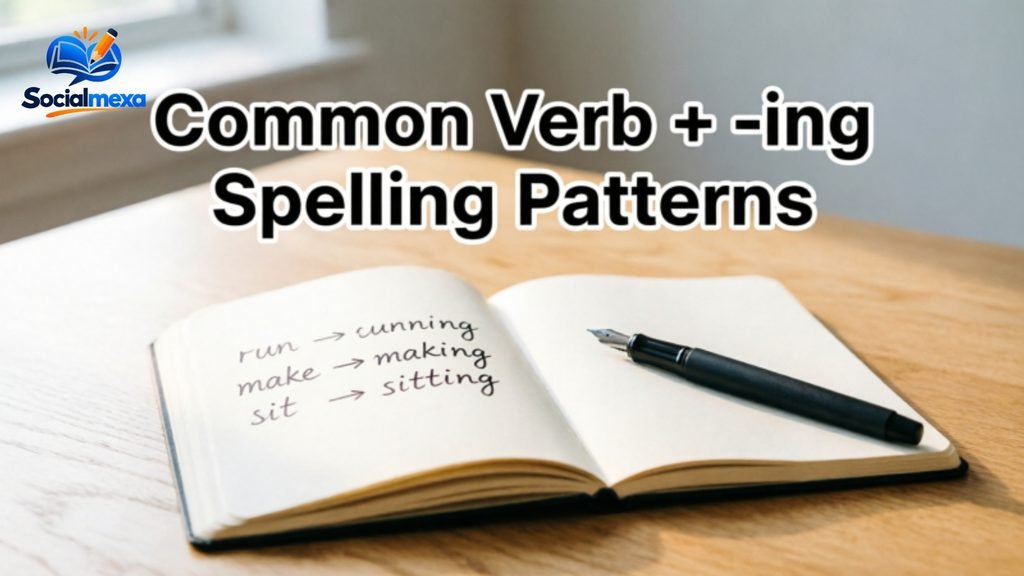
- Stressed final syllable, single vowel and consonant: double the consonant (run to running, stop to stopping)
- Unstressed final syllable: do not double (open to opening, listen to listening, happen to happening)
- Verb ends in silent “e”: drop the “e” before adding ing (make to making, hope to hoping)
- Verb ends in two consonants: just add ing, no changes (jump to jumping, work to working)
Opening or Openning Examples
- “Please confirm the store opening hours.” Correct
- “The openning of the new library was delayed.” Incorrect
- “Her opening remarks set a warm tone.” Correct
- “I found an openning in my schedule tomorrow.” Incorrect
Spelling Rule (British vs American English)
Here is something that surprises a lot of people. This is not one of those British versus American spelling situations like “colour” and “color.” Both British and American English use the exact same spelling for this word.
Key Point
There is only one accepted spelling worldwide, and that is “opening.” No regional dialect changes this.
Comparison Table
| Region | Spelling Used |
|---|---|
| United States | Opening |
| United Kingdom | Opening |
| Australia | Opening |
| Canada | Opening |
Opening Meaning
To recap simply, “opening” means the start of an event, an available gap or position, or the act of making something accessible. Context tells you which meaning applies, but the spelling never changes across any of them.
Which Spelling Should You Use?

Simple Answer
Always use “opening.” There is no situation, formal or informal, academic or casual, where “openning” is acceptable.
Use “Opening” In:
- Business emails and reports
- Job postings and resumes
- Event announcements
- Casual conversation and texting
- Creative writing and storytelling
Never Use: “Openning”
This spelling has no legitimate use case. It is purely a typo that spreads because people copy what they see without checking it.
Openning or Opening Synonym
If you want variety in your writing, try these alternatives depending on context: inauguration, launch, debut, commencement, vacancy, gap, or aperture. Each one fits a slightly different flavor of “opening,” so pick based on tone.
Common Mistakes with Opening
Mistake 1: Adding an Extra “n”
This is the classic error. Writers hear the “n” sound and instinctively want to reinforce it with a second letter, even though the spelling rule says otherwise.
Mistake 2: Confusing Pronunciation with Spelling
English pronunciation does not always match spelling logic. Just because a word sounds like it needs doubling does not mean it actually does.
Mistake 3: Applying the Wrong Doubling Rule
Some writers remember that certain verbs double their final consonant before “ing” but forget that the rule only applies when the last syllable is stressed. That single detail changes everything.
Mistake 4: Copying Common Online Typos
Autocomplete, social media captions, and even some low quality websites spread “openning” simply because it looks close enough at a glance. Repetition makes an error feel familiar, but familiarity does not make it correct.
Opening in Everyday Examples

In Daily Life
“I love the smell of a fresh bakery opening its doors in the morning.”
In Emails
“We are pleased to announce the opening of our new branch next Monday.”
On Social Media
“Grand opening this weekend! Come say hi and grab a free coffee.”
In Formal Writing
“The committee’s opening statement outlined three key priorities for the fiscal year.”
In Business Communication
“Please review the attached document regarding the opening of the new client account.”
Opening Verb
As a verb, “opening” is the present participle of “open.” It shows an ongoing action, as in “She is opening the box right now.” It also pairs with helping verbs to form continuous tenses, such as “They have been opening new stores across the country.”
Common Phrases Using “Opening”
Opening Ceremony
The formal event that marks the start of something big, like the Olympics or a new building.
Job Opening
An available position at a company that is currently hiring.
Opening Statement
The first remarks made in a courtroom, meeting, or presentation, setting the tone for what follows.
Grand Opening
A celebratory event marking the first day a business officially operates.
Opening on Date
When businesses or events announce a specific launch day, this phrase appears constantly, as in “Opening on March 3rd” or “Now opening on Friday.” The spelling stays exactly the same regardless of how the phrase is used.
Easy Trick to Remember the Correct Spelling
Here is a simple memory trick. Think of the phrase “one n is open enough.” If you catch yourself reaching for a second “n,” pause and remember that “open” already has everything it needs. One “n,” always.
Opening – Usage & Trends
Key Insight
Search data consistently shows that “openning” is one of the most frequently searched misspellings tied to business and retail terms, largely because store owners and marketers type quickly and rarely proofread promotional posts.
Common Uses
The word shows up heavily in retail, real estate listings, job boards, and event marketing, which is exactly why getting the spelling right matters for professional credibility.
Opening vs Openning – Comparison Table
| Feature | Opening | Openning |
|---|---|---|
| Dictionary recognized | Yes | No |
| Correct in formal writing | Yes | No |
| Common in casual typos | No | Yes |
| Accepted spelling variant | Standard | None |
Frequently Asked Questions
Which spelling is correct, openning or opening?
“Opening” is correct. “Openning” is always a misspelling.
Which is correct, opened or openned?
“Opened” is correct. Just like “opening,” the past tense form never doubles the final “n.”
Which is correct: “opened” or “opening”?
Both are correct, but they serve different tenses. “Opened” is past tense, while “opening” describes an ongoing action or a noun form. Your sentence structure determines which one you need.
How do you spell opening in English?
O-P-E-N-I-N-G. Six letters after the double check, one “n,” no exceptions.
Final Verdict: Opening or Openning?
“Opening” wins, every time, in every dialect, in every context. “Openning” is nothing more than a typo that spread because it looks convincing at a glance. Now that you know the simple stress rule behind it, you will never second guess this spelling again.

Emily Carter is an English language writer who creates simple guides on grammar, word meanings, spelling, slang, and everyday English. Her goal is to make confusing language topics clear, practical, and easy to understand.
4 thoughts on “Opening or Openning? Get the Correct Spelling Now”