


“Never give up” is one of the most common pieces of advice in English. It also gets tired fast. If you use it in every email, caption, speech, or story, it stops landing.
This guide gives you more than 130 alternatives, grouped by tone and situation. You will see what each one really says, how strong it feels, and where it fits best.
The Short Answer
The best way to say “never give up” depends on who you are talking to. Use “persevere” or “stay the course” in formal writing, “hang in there” or “you’ve got this” for a friend, and “never back down” or “refuse to quit” when you want bold, motivational energy. Pick the phrase that matches the person’s mood, not just the meaning.
What “Never Give Up” Really Means

At its core, “never give up” means to keep trying toward a goal even when it gets hard, slow, or discouraging. It is usually an instruction or encouragement: you keep going, and you do not quit.
People use it in a few main ways:
- As encouragement: telling someone else to keep trying.
- As a personal vow: promising yourself you will not stop.
- As a description: saying a person or team is determined and resilient.
- As a slogan: using it in speeches, posters, captions, and brand messages.
Most people who search for synonyms want one of three things: a fresher phrase for writing, a more professional phrase for work, or a caption or quote for sharing. This guide covers all three.
| Related Articles You’ll Love |
| Verbage or Verbiage? Get the Spelling Right? Get the Spelling Right |
| Analysing or Analyzing? Get the Spelling Right |
| Lilies or Lillies? Discover the Correct Spelling |
How These Synonyms Differ
Many of these phrases look interchangeable, but they carry different feelings.
- Strength: “Keep trying” is gentle. “Never surrender” is intense.
- Formality: “Persevere” suits a report. “Hang in there” suits a text message.
- Focus: “Persist” is about continuing an action. “Resilient” is about recovering from setbacks. “Endure” is about getting through pain or hardship.
- Direction: Some phrases speak to others (“you’ve got this”). Others describe yourself (“I’m not done yet”). Others describe a third person (“she refused to quit”).
Keep these differences in mind as you read the lists below.
The Most Important Synonyms Explained
These six options cover most everyday needs.
Persevere
To persevere is to keep going toward a goal despite difficulty, usually over a long time. It sounds formal and respectful, so it works well in essays, speeches, and professional writing.
Example: Students who persevere through the first semester often find the second one easier.
Persist
To persist is to continue doing something even when it meets resistance or does not work right away. It is a little more neutral than “persevere” and can focus on a single action or effort.
Example: If the error message appears again, persist with the troubleshooting steps.
Keep Going
This is the simplest and most flexible option. It works in speech, texts, coaching, and casual writing. It has no drama, which is why it often feels sincere.
Example: You’re tired, I know. Keep going, you’re closer than you think.
Hang in There
This is a warm, informal phrase of comfort. It tells someone to hold on through a hard period, not necessarily to push harder.
Example: Hang in there. This week is almost over.
Stay the Course
This phrase means to keep following your plan despite pressure to change direction. It suits business, strategy, and long-term goals.
Example: The board decided to stay the course despite a slow first quarter.
Don’t Quit
This is direct and punchy. It works well in motivation, sports, and moments when someone is close to stopping.
Example: Don’t quit now. You’ve already done the hard part.
Comparison Table: Close Synonyms at a Glance
| Synonym | Meaning Nuance | Tone | Example Sentence |
| Persevere | Keep going toward a goal over time despite difficulty | Formal, respectful | She persevered through years of rejections before publishing her novel. |
| Persist | Continue an action despite resistance | Neutral, steady | He persisted with his application until the school responded. |
| Endure | Get through hardship or pain | Serious, heavy | The family endured a long winter without reliable heat. |
| Press on | Move forward despite tiredness or doubt | Determined, slightly informal | We were behind schedule, but we pressed on. |
| Hang in there | Hold on during a difficult period | Warm, casual | Hang in there, your exams end on Friday. |
| Stay the course | Keep following a chosen plan | Professional, strategic | The company stayed the course on its long-term strategy. |
| Don’t quit | Do not stop, especially when close to stopping | Direct, motivational | Don’t quit now, the finish line is right there. |
| Never surrender | Refuse to be beaten, even when losing | Bold, dramatic | Never surrender your goals just because the road is long. |
| Keep the faith | Keep trusting that things will work out | Hopeful, gentle | Keep the faith. Your hard work will show results. |
| Follow through | Finish what you started | Practical, workplace | She always follows through on her commitments. |
| Resilient | Able to recover after setbacks | Positive, descriptive | The resilient team bounced back after a tough season. |
| Tenacious | Holding on firmly to a goal | Strong, admiring | A tenacious researcher, he tested the idea fourteen times. |
Short Verbs and Everyday Phrases for Persistence
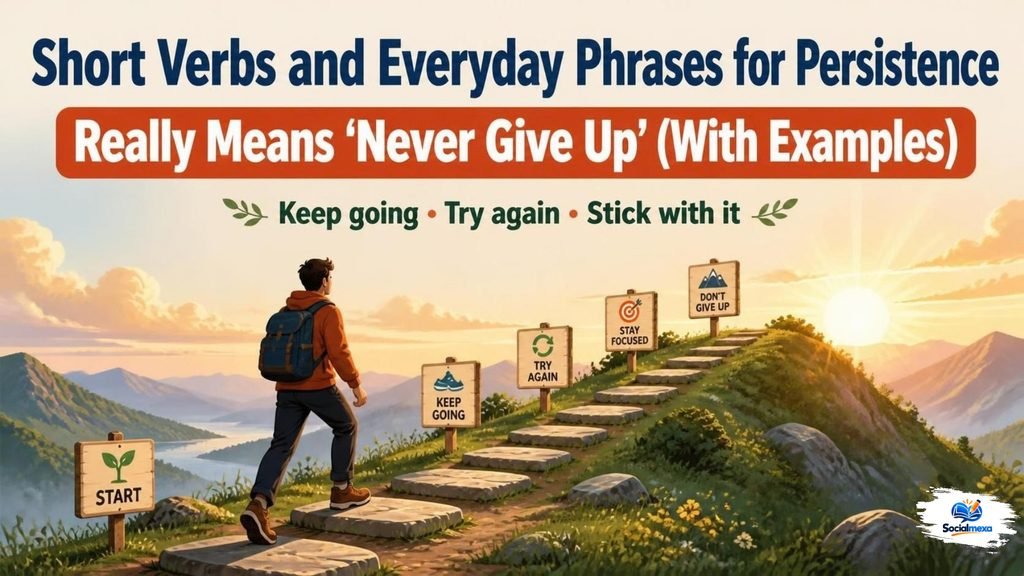
These are simple, flexible, and useful in almost any setting.
- Persist: She persisted even after the third rejection email.
- Persevere: He persevered through two years of night classes.
- Endure: The hikers endured the cold and reached camp by dark.
- Press on: We were tired, but we pressed on.
- Push on: Push on a little longer. The summit is close.
- Carry on: Carry on with the plan, even if progress feels slow.
- Soldier on: He soldiered on through the flu to finish the project.
- Hold on: Hold on, help is coming.
- Hold firm: She held firm when everyone doubted her idea.
- Stand firm: Stand firm on your goals this year.
- Stay strong: Stay strong. The hardest part is behind you.
- Keep going: Keep going, even if the steps are small.
- Keep trying: Keep trying until the method clicks.
- Keep at it: Keep at it. Skills like this take time.
- Stick with it: Stick with it for one more month and see the difference.
Ways to Encourage Someone Else
Use these when you are talking to a friend, a teammate, a student, or a child. They are warm and conversational.
- You’ve got this: You’ve got this. I’ve seen you handle harder things.
- Don’t quit now: Don’t quit now. You’re nearly there.
- Hang in there: Hang in there. Better days are coming.
- Keep your head up: Keep your head up, today was only one setback.
- Stay positive: Stay positive, the next attempt could be the one.
- Keep believing: Keep believing in the plan you made.
- Don’t lose hope: Don’t lose hope. Things can change quickly.
- Don’t throw in the towel: Don’t throw in the towel after one bad round.
- Keep pushing: Keep pushing, your effort is adding up.
- Keep fighting: Keep fighting for what matters to you.
- Hold your head high: Hold your head high. You did your best.
- One more try: Give it one more try before you decide.
- Take it one step at a time: Take it one step at a time and don’t look too far ahead.
- Don’t stop now: Don’t stop now. The results are starting to show.
- You’re almost there: You’re almost there, so stay with it.
- Stay with it: Stay with it, even on the slow days.
- Keep your chin up: Keep your chin up. This is not the end of the story.
- Never stop believing in yourself: Never stop believing in yourself, even when others do.
- Believe in yourself: Believe in yourself and take the next step.
- Don’t count yourself out: Don’t count yourself out yet. You still have time.
Formal and Professional Alternatives
These phrases fit emails, reports, speeches, and workplace writing. They sound calm and credible.
- Remain determined: The team remained determined throughout the audit.
- Stay committed: Please stay committed to the timeline we agreed on.
- Stay the course: We will stay the course while we gather more data.
- Show resilience: Leaders show resilience when plans change.
- Be tenacious: Be tenacious when negotiating, but stay respectful.
- Stay resolute: The committee stayed resolute under public pressure.
- Maintain your resolve: Maintain your resolve during the final review stage.
- Remain steadfast: She remained steadfast in her support for the project.
- Persist in your efforts: Persist in your efforts to reach the client.
- Keep your focus: Keep your focus on the outcome, not the obstacles.
- Stay focused on the goal: Stay focused on the goal when priorities shift.
- Demonstrate perseverance: Applicants should demonstrate perseverance in their field.
- Stay dedicated: He stayed dedicated to the research for a decade.
- Hold to your commitment: Hold to your commitment, even when the budget tightens.
- Keep your eyes on the prize: Keep your eyes on the prize while handling the small tasks.
- See it through: Once you start a project, see it through.
- Follow through: Follow through on every action item from the meeting.
- Remain undeterred: The founder remained undeterred by early criticism.
- Stay relentless: Stay relentless in pursuing quality.
- Be unwavering: Be unwavering in your standards, but flexible in your methods.
Bold and Powerful Motivational Phrases
These are stronger and more dramatic. They work in speeches, posters, coaching, and high-energy captions.
- Never back down: Never back down from a challenge you believe in.
- Never surrender: Never surrender your dream because the road is long.
- Never say die: Her never say die attitude carried the team to the final.
- Never stop fighting: Never stop fighting for a better future.
- Never throw in the towel: He never throws in the towel, even when behind.
- Fall down, get back up: Fall down, get back up, and try again.
- Rise again: Every setback is a chance to rise again.
- Rise and try again: Rise and try again, wiser than before.
- Keep rising: Keep rising, no matter how many times you fall.
- Bounce back: Great teams know how to bounce back.
- Come back stronger: Take a rest, then come back stronger.
- Refuse to quit: Refuse to quit, even when the path is unclear.
- Refuse to fold: She refused to fold under pressure.
- Fight to the end: Fight to the end, because it is not over until it is over.
- Fight on: Fight on, the finish is near.
- Push through: Push through the doubt and take the next step.
- Power through: Power through the hard days and results will follow.
- Break through the wall: Break through the wall by trying a new approach.
- Go the distance: He promised to go the distance, no matter what.
- Finish what you started: Finish what you started, even if it is imperfect.
Hopeful and Gentle Ways to Say It
Not everyone wants a loud pep talk. These lines work better when someone is tired, sad, or discouraged.
- Keep the faith: Keep the faith. Things are moving, even if slowly.
- Hold on to hope: Hold on to hope, even in small amounts.
- Hope is not lost: Hope is not lost while you are still trying.
- Trust the process: Trust the process, and give it time.
- Believe it will get better: Believe it will get better, because change takes time.
- Brighter days ahead: There are brighter days ahead, so be patient with yourself.
- This too shall pass: This too shall pass, and you will be stronger for it.
- Keep hope alive: Keep hope alive, even if you need to rest first.
- Keep dreaming: Keep dreaming, and keep working at it.
- Stay hopeful: Stay hopeful, one day at a time.
- Trust your journey: Trust your journey, even when the map looks messy.
- Better days are coming: Better days are coming, so do not stop now.
- Don’t give up on yourself: Don’t give up on yourself. You are still growing.
- Keep your heart in it: Keep your heart in it, even when motivation dips.
- Keep walking: Keep walking. Slow progress is still progress.
Resume and Workplace Language “Never Give Up“
On a resume or in a performance review, “never give up” sounds vague. Show the quality through action instead. These phrases describe persistence in a specific, professional way.
- Demonstrated perseverance: Demonstrated perseverance by completing certification while working full time.
- Showed tenacity under pressure: Showed tenacity under pressure during a major product launch.
- Persisted through setbacks: Persisted through setbacks to deliver the project on schedule.
- Remained resilient: Remained resilient during a company-wide restructuring.
- Maintained momentum: Maintained momentum on a long-running migration project.
- Overcame obstacles: Overcame obstacles in the supply chain to meet client deadlines.
- Followed through to completion: Followed through to completion on every assigned initiative.
- Stayed committed to long-term goals: Stayed committed to long-term goals despite shifting priorities.
- Drove projects to completion: Drove projects to completion across three departments.
- Sustained effort: Sustained effort over eighteen months to reach full adoption.
- Adapted and persisted: Adapted and persisted when the original plan failed.
- Delivered despite setbacks: Delivered despite setbacks, including a late vendor change.
Sports and Competition Phrases “Never Give Up“
Coaches, athletes, and fans have their own way of saying it. These are energetic and physical.
- Leave it all on the field: Leave it all on the field, and you’ll have no regrets.
- Play until the final whistle: Play until the final whistle, no matter the score.
- Never stop competing: Never stop competing, even when the game looks lost.
- Fight for every point: Fight for every point, one rally at a time.
- Go the extra mile: Go the extra mile in practice, and it shows on game day.
- Dig deep: Dig deep, you still have more in you.
- Give it everything: Give it everything for the last lap.
- Stay in the game: Stay in the game, because momentum can change quickly.
- Finish strong: Finish strong, whatever the scoreboard says.
- Fight to the final buzzer: Fight to the final buzzer, because anything can happen.
Social Media Captions and Modern Phrases

Short, simple, and easy to repeat. These work as captions, bios, and quotes on images.
- Trust the grind: Early mornings, late nights. Trust the grind.
- Stay locked in: New goal, same focus. Stay locked in.
- Keep showing up: Some days are slow. Keep showing up anyway.
- Still standing: Rough year, but still standing.
- Try again tomorrow: Didn’t work today. Try again tomorrow.
- Keep the momentum: Small wins add up. Keep the momentum.
- Quitting is not an option: I’m tired, but quitting is not an option.
- I’m not done yet: Not the finish line. I’m not done yet.
- Eyes on the goal: Distractions everywhere. Eyes on the goal.
- One day at a time: Big dream, small steps. One day at a time.
Words to Describe Someone Who Never Gives Up
These adjectives are useful in essays, character descriptions, reviews, and recommendation letters. They are not interchangeable, and the differences matter.
- Tenacious: A tenacious reporter, she followed the story for months.
- Indomitable: The indomitable spirit of the town carried it through the flood.
- Unyielding: He was unyielding in his belief that the school could improve.
- Undaunted: Undaunted by the odds, they entered the competition anyway.
- Dogged: Her dogged effort finally paid off.
- Relentless: The relentless training schedule prepared them for anything.
- Unbreakable: They formed an unbreakable bond during the long expedition.
- Resilient: Resilient students tend to recover quickly from a bad grade.
- Steadfast: He remained steadfast in pursuing his degree.
- Determined: A determined learner can master almost any skill.
- Unstoppable: Once she found her method, she felt unstoppable.
- Persistent: The persistent salesperson called back three times.
Context-Specific Usage
In an Email
Keep it warm and professional. Avoid slogans.
- “Thanks for staying committed to this project. Your persistence made a real difference.”
- “I know the last few weeks have been difficult. Please hang in there, and let me know how I can help.”
On a Resume
Show persistence through results, not through the phrase itself. Use verbs such as “persisted,” “followed through,” and “overcame.” Pair them with a specific outcome, such as a project finished or a goal reached.
In an Essay
Choose precise vocabulary. “Persevere,” “endure,” “resilience,” and “determination” read well in academic writing. Avoid casual phrases such as “hang in there” unless you are quoting someone.
In Conversation
Short and natural wins. “Keep going,” “you’ve got this,” and “don’t quit now” sound more human than formal wording. Match the energy of the person you are talking to.
On Social Media
Short phrases with rhythm work best. “Still standing,” “keep showing up,” and “try again tomorrow” fit a caption without sounding preachy.
In Storytelling
Show the quality instead of naming it. Instead of writing “she never gave up,” describe what she does: she rewrites the opening pages again, she walks back to the trailhead, or she asks one more time. Adjectives such as “dogged,” “undaunted,” and “unyielding” can add flavor, but actions are more convincing.
When Not to Use These Synonyms
Not every phrase fits every moment. Here are the main cases to watch.
- “Never surrender,” “never back down,” and “fight to the end”: These can sound too intense for a normal workplace email or a casual chat.
- “Hang in there”: Be careful with someone who is grieving or in serious distress. It can sound light for a heavy situation. A kinder, more personal message usually works better.
- “Soldier on”: It can suggest someone is suffering quietly. Avoid it if you do not want to encourage ignoring pain or exhaustion.
- “Relentless” and “unyielding”: These can sound harsh when describing a coworker or a manager. They may suggest inflexibility rather than strength.
- “Dogged”: It usually points to stubborn effort and may sound less polished in formal praise. “Persistent” or “determined” is safer on a recommendation letter.
- “Trust the process”: Avoid it when someone needs real, practical help. It can sound like a brush-off.
- Any phrase when the goal is not working: Sometimes the better advice is to rest, change the plan, or stop. “Never give up” is not always the right message, and a thoughtful alternative may be “adjust and try again.”
Antonyms of “Never Give Up”
These words and phrases express the opposite idea: stopping, quitting, or yielding.
- Give up
- Quit
- Surrender
- Throw in the towel
- Call it quits
- Back down
- Give in
- Cave in
- Fold
- Walk away
- Abandon the goal
- Bail out
- Lose heart
- Drop out
- Stop trying
Related Words and Phrases
These terms often appear near “never give up” in writing and conversation.
- Perseverance
- Resilience
- Determination
- Grit
- Tenacity
- Willpower
- Commitment
- Discipline
- Resolve
- Drive
- Comeback
- Second wind
- Uphill battle
- Setback
- Adversity
- Mindset
- Stay the course
- Go the extra mile
- Keep the faith
- Push through
Frequently Asked Questions
What is another way to say “never give up”?
Common alternatives include “keep going,” “don’t quit,” “persevere,” “stay the course,” and “hang in there.” Choose based on tone: formal, friendly, or bold.
What is a formal way to say “never give up”?
“Persevere,” “remain determined,” “stay committed,” and “demonstrate resilience” all work in professional and academic writing.
What is a short motivational phrase for “never give up”?
“Keep going,” “don’t quit,” “you’ve got this,” and “not done yet” are short and easy to remember. They work well in captions and speeches.
What is the difference between “persevere” and “persist”?
Both mean to keep going. “Persevere” usually suggests a longer effort toward a meaningful goal despite difficulty, while “persist” can describe continuing with any action, even a small one, despite resistance.
How do I say “never give up” on a resume?
Avoid the phrase itself. Use action verbs and results, such as “persisted through setbacks to deliver the project on time” or “followed through on a multi-year initiative.”
Is “never give up” a cliché?
It can be, especially when used with no context. Using a specific example or a fresher synonym helps the message feel more genuine.
What is a good way to say it to someone who is struggling?
Gentle phrases such as “hang in there,” “one step at a time,” “better days are coming,” and “keep the faith” tend to feel more supportive than commands. Sometimes simply saying you believe in them works best.
What is the opposite of “never give up”?
The most common opposites are “give up,” “quit,” “surrender,” and “throw in the towel.”
Conclusion
“Never give up” is a good message, but it works best when the words match the moment. A formal report needs “persevere” or “stay the course.” A tired friend might need “hang in there” or “one step at a time.” A caption or poster can handle something bolder, such as “refuse to quit” or “still standing.”
Pick one phrase that fits your audience, add a specific detail or example, and let the message feel like it came from a real person. The strongest encouragement is rarely the loudest. It is the line that sounds true to the reader at the moment they need it.

Emily Carter is an English language writer who creates simple guides on grammar, word meanings, spelling, slang, and everyday English. Her goal is to make confusing language topics clear, practical, and easy to understand.
2 thoughts on “130+ Powerful Ways to Say “Never Give Up” (With Examples)”