


“Okay” is one of the most useful words in English, and one of the easiest to overuse. It can mean yes, I understand, that is fine, or I am doing so-so, all in the same day. The trouble is that each of those jobs has a better, clearer word.
This guide groups more than 90 alternatives by what you actually mean, so you can pick the right one for a text, an email, an essay, or a story.
Quick Answer: What Can You Say Instead of “Okay”?
Choose a replacement based on the meaning. Say “Sure” or “Sounds good” to agree, “Got it” or “Understood” to confirm you heard something, and “Fine” or “Decent” when something is acceptable but not great. For formal writing, “Certainly,” “Agreed,” and “Acceptable” work well.
What “Okay” Really Means
“Okay” (also written “OK”) does several jobs, and knowing which one you need is the whole trick to choosing a better word.
- Agreement: “Okay, let’s do it.”
- Permission or approval: “Is it okay if I leave early?”
- Acknowledgement: “Okay, I see what you mean.”
- Average quality: “The movie was okay.”
- Well-being: “I’m okay, thanks for asking.”
- A conversation marker: “Okay, so here is the plan.”
Most people searching for synonyms want one of two things: a word that sounds less repetitive, or a word that fits a specific tone, such as polite, professional, or casual. Both are covered below. Both “okay” and “OK” are widely used, so pick one spelling and stay consistent.
| Articles You Shouldn’t Miss |
| Lilies or Lillies? Discover the Correct Spelling |
| Many or Meny? Discover the Correct Spelling & Meaning |
| Thiefs or Thieves? Get the Correct Spelling Fast |
Ways to Say “Okay” When You Agree
Use these when someone makes a suggestion and you are saying yes.
Everyday agreement: Yes, Yeah, Yep, Yup, Sure, Right, Exactly, Fair enough, You bet
Stronger agreement: Absolutely, Definitely, Certainly, Of course, Agreed, Indeed
Sure
“Sure” is relaxed and friendly. It says yes without making a big deal of it. It can sound lukewarm if your voice or punctuation is flat, so add warmth when you mean it: “Sure, happy to.”
Absolutely
“Absolutely” is a firm, enthusiastic yes. Use it when you want the other person to know you are fully on board. It is too strong for small, low-stakes choices, where it can sound dramatic.
Fair enough
“Fair enough” means you accept the other person’s point, even if you would have chosen differently. It is a good pick when you are agreeing without being thrilled.
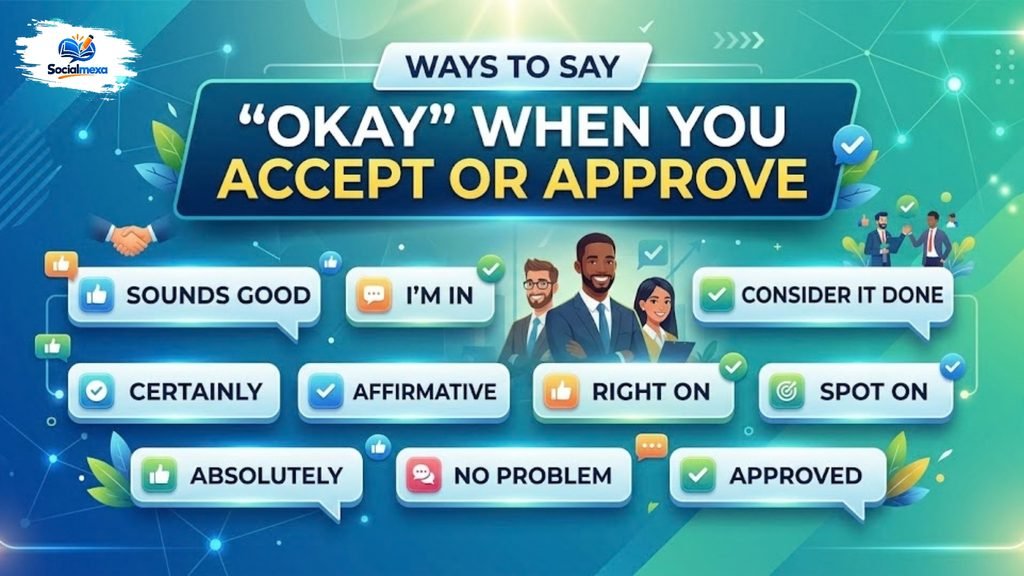
Ways to Say “Okay” When You Accept or Approve
Use these when you are giving permission, accepting a plan, or saying you are willing.
Accepting a plan: Alright, Sounds good, Works for me, Fine by me, That works, Sounds like a plan, Deal, I’m in, Count me in, Why not
Giving permission: Go ahead, Be my guest, No problem, No worries, As you wish, Granted
Willing and warm: Will do, Happy to, With pleasure, You got it, Done
Positive sign-off: Great, Perfect, Good to go, All set
Sounds good
“Sounds good” is probably the most natural all-purpose replacement. It works in conversation, chat messages, and workplace emails. It confirms the plan and keeps the mood positive.
No problem
“No problem” tells the other person that helping them is not a burden. It fits best as an answer to a request or a thank you. It is less suitable for replying to a plan or a statement of fact.
Ways to Say “Okay” When You Understand
Use these to show you received the information, not necessarily that you agree with it.
Casual: Got it, Gotcha, I see, Makes sense, Point taken
Professional: Understood, Noted, Acknowledged, Received, Confirmed, Message received
Radio and team style: Roger, Copy that, Affirmative
Got it
“Got it” says “I understand, and I know what to do next.” It is short, clear, and works in almost any setting short of very formal writing.
Understood
“Understood” is a step more formal than “got it.” It suits work messages, customer service, and replies to instructions from a manager or client.
Ways to Say “Okay” When Something Is Just Average
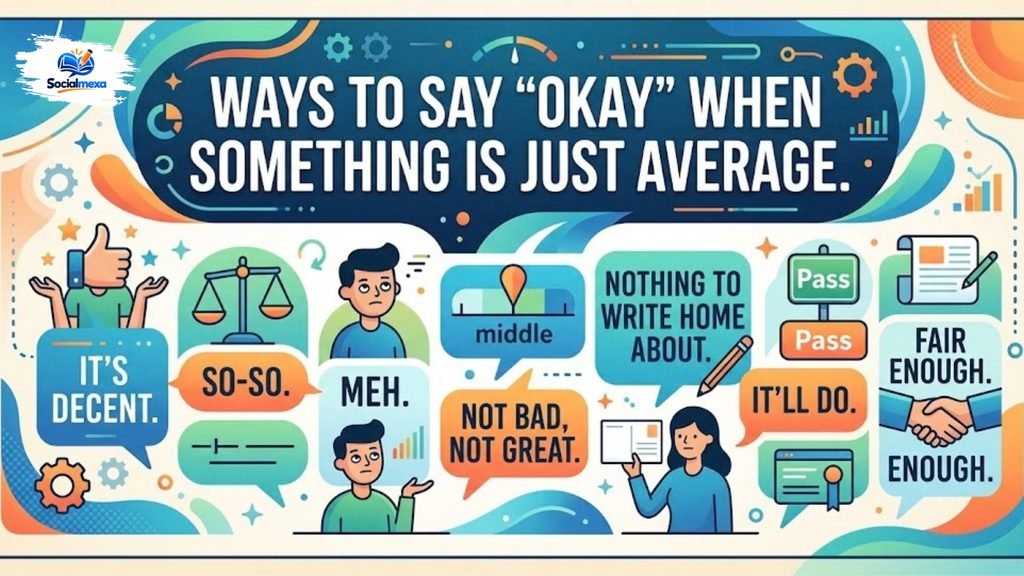
This is where “okay” means acceptable, not great. Words here differ a lot in how positive they sound.
Mildly positive: Decent, Not bad, Good enough, Reasonable, Satisfactory, Fair
Neutral: Fine, Acceptable, Adequate, Average, Passable, Tolerable, So-so, Middling
Fine
“Fine” is tricky because tone changes everything. “The hotel was fine” is neutral. “I’m fine” in a flat voice can sound like the opposite. In writing, add detail when you do not want to sound cold: “The hotel was fine, clean and quiet.”
Ways to Say “I’m Okay” About How You Feel
Use these when someone asks how you are doing.
I’m fine, I’m good, Doing well, Not too bad, Can’t complain, Getting by, Holding up, Hanging in there, I’m managing
“Not too bad” and “can’t complain” sound relaxed and slightly modest. “Hanging in there,” “getting by,” and “I’m managing” suggest you are coping with something difficult, so use them when that is true.
Casual and Texting Ways to Say “Okay”
These are for friends, chats, and social media. Skip them in formal writing.
K, Kk, Bet, Cool, Aight, Sweet, Say less, Word, Cool beans, Right on, Okey-dokey, A-OK
A short warning about “K”: in text messages, a lone “k” can come across as curt or annoyed. If you want to sound friendly, “Sounds good” or “Cool” is safer.
Formal and Professional Ways to Say “Okay”
Use these in business emails, official letters, and polite requests.
Certainly, Very well, Very good, Agreed, Approved, I concur, No objection, Suitable, Agreeable, Acceptable, Satisfactory
“I concur” and “No objection” are quite formal and fit meetings, committees, and legal or academic settings. In a normal workplace email, “That works for me” or “Agreed” is plenty.
Synonym Comparison Table
| Synonym | Meaning Nuance | Tone | Example Sentence |
| Sure | Easy yes, low pressure | Casual, friendly | “Sure, I can send that over today.” |
| Absolutely | Strong, full agreement | Enthusiastic | “Absolutely, that plan makes sense.” |
| Fair enough | Accepting a point you did not fully expect | Relaxed, mild | “Fair enough, let’s try your way first.” |
| Sounds good | Accepts a plan | Warm, everyday | “Sounds good, see you at six.” |
| Works for me | The plan suits your needs | Casual, practical | “Thursday works for me.” |
| No problem | Happy to help, not a burden | Friendly | “No problem, I’ll cover the morning shift.” |
| Go ahead | Gives permission | Neutral, open | “Go ahead and start without me.” |
| Will do | Promises to act | Casual, reliable | “Will do, I’ll call them after lunch.” |
| Got it | Understood, ready to act | Casual, clear | “Got it, I’ll fix the file tonight.” |
| Understood | Instruction received | Polite, professional | “Understood, I will update the report.” |
| Noted | Information recorded, no promise | Brief, businesslike | “Noted, thanks for the heads up.” |
| Roger | Message received | Playful or technical | “Roger, we’re leaving at nine.” |
| Fine | Acceptable, nothing special | Neutral, tone sensitive | “The soup was fine.” |
| Decent | Better than average | Mildly positive | “It’s a decent laptop for the price.” |
| Not bad | Pleasantly acceptable | Understated | “Not bad for a first attempt.” |
| So-so | Mixed or mediocre | Casual, slightly negative | “My day was so-so.” |
| Adequate | Meets the minimum | Formal, cool | “The room was adequate for our needs.” |
| Can’t complain | Doing well enough | Easygoing | “Can’t complain, work has been steady.” |
| Bet | Agreement, I’m on board | Slang, young | “Bet, I’ll meet you there.” |
| Certainly | Polite, confident yes | Formal, courteous | “Certainly, I’ll send the details.” |
Antonyms of “Okay”
The opposite depends on the meaning you chose.
- Disagreement or refusal: No, Nope, Absolutely not, I disagree, Not at all, Certainly not, I’d rather not
- Poor quality: Bad, Terrible, Awful, Poor, Unacceptable, Unsatisfactory, Subpar
- Not well: Not okay, Struggling, Unwell, Not great, Rough
- Not understood: Confused, I don’t follow, Unclear
Related Words and Phrases
These are not strict synonyms, but they sit close to “okay” in everyday use.
- All right (the two-word spelling of “alright”)
- OK with it
- On board
- Up for it
- Good to know
- That’s fine
- No issue
- Thumbs up
- Green light
- Go-ahead
- Seal of approval
How to Use These Words in Different Settings

In conversation
Match the other person’s energy. “Sounds good” and “Sure” fit most chats. If someone shares bad news, avoid “okay” as your only reply. Try “I understand” or “That makes sense.”
In email
Use “Understood,” “Noted,” “Agreed,” or “That works for me.” If you are confirming a task, add detail: “Understood, I’ll send the draft by Friday.”
In an essay
Avoid “okay” in formal academic writing. Use “acceptable,” “adequate,” or “satisfactory” to describe quality, and “agree” or “consent” for approval. Be specific when you can, such as “The results were adequate but not conclusive.”
On a resume
Skip “okay” completely. It sounds weak. If you need to describe performance, use clear facts, such as numbers, results, or responsibilities, instead of a vague quality word.
On social media
Casual choices such as “Cool,” “Bet,” “Say less,” and “Sounds good” are all common. Use them with friends and followers, but keep in mind that slang can age quickly and may not suit every audience.
In storytelling
Dialogue should sound like the character. A teenager might say “Aight.” A military officer might say “Understood.” A nervous employee might say “Sure, no problem,” while clearly meaning the opposite. A word choice can reveal attitude without extra explanation.
When Not to Use These Synonyms
Not every replacement works in every situation.
- “Absolutely” and “Definitely”: Avoid them for small, uncertain choices. They can sound insincere if you are not fully committed.
- “Fine”: Avoid it if you want to sound warm or enthusiastic. Without extra detail, it can read as cold or reluctant.
- “K” and “Kk”: Avoid them in professional messages and when someone is upset. They can look dismissive.
- “No problem”: Do not use it to reply to a complaint or a serious request. “Understood” is safer.
- “Noted”: Do not use it when someone expects a real answer. It confirms receipt, not agreement, and can sound brush-off if overused.
- “Roger” and “Copy that”: Keep them for informal teamwork, humor, or settings where that style is normal.
- “Bet,” “Aight,” and “Say less”: Avoid them in formal writing, with people you do not know well, or in audiences where the slang may not be familiar.
- “I concur” and “No objection”: Do not use them in casual talk. They can sound stiff or sarcastic.
- “So-so” and “Tolerable”: Do not use them if you want to be polite about someone’s work. They can come across as criticism.
Frequently Asked Questions
What is the most polite way to say okay?
“Certainly,” “Of course,” and “Very well” are polite and formal. In everyday work messages, “Sounds good” and “That works for me” are friendly and professional.
What is a professional alternative to okay in an email?
Use “Understood,” “Noted,” “Agreed,” or “That works for me.” Choose “Understood” for instructions, “Agreed” for decisions, and “That works for me” for scheduling.
Is “OK” or “okay” the correct spelling?
Both are in common use. Choose one and use it consistently. In formal writing, check the style guide your school or publication follows.
What is a casual way to say okay?
“Sure,” “Cool,” “Sounds good,” “Got it,” and “No worries” are all easy, natural options. Among younger speakers, “Bet” and “Say less” are common in texts and online chats.
What can I say instead of “I’m okay”?
Try “I’m fine,” “I’m good,” “Can’t complain,” “Not too bad,” or “Doing well.” If things are tough, “Hanging in there” or “Getting by” is more honest.
What is the difference between “fine” and “okay”?
They overlap, but “fine” can sound more neutral or more reserved, depending on tone. “Okay” is more flexible and can be warm or flat. If you want to be clear and positive, “good” or “sounds good” is usually safer than either.
Can “okay” sound rude?
It can, mostly because of tone. A short “okay” or a single “k” can sound annoying or uninteresting. Adding a few words, such as “Okay, thanks for letting me know,” keeps the mood friendly.
What is the best word to show I understand something?
“Got it” is best for casual settings, and “Understood” is best for professional ones. “Makes sense” also works when you want to show that you followed the reasoning.
Conclusion
“Okay” works because it is flexible, but that flexibility is also why it can sound vague. When you ask yourself whether you are agreeing, accepting, acknowledging, or rating something, the best replacement usually becomes clear.
Start with a few reliable choices: “Sure” and “Sounds good” for agreement, “Got it” and “Understood” for confirming, and “Decent” or “Fine” for average quality. Then add stronger or more specific options as the situation calls for them, and keep the tone in mind, because the same word can feel warm in one message and cold in another.

Emily Carter is an English language writer who creates simple guides on grammar, word meanings, spelling, slang, and everyday English. Her goal is to make confusing language topics clear, practical, and easy to understand.
2 thoughts on “90+ Ways to Say “Okay” Naturally: Find the Best Ones”