


Typing “reciept” and watching your screen underline it in angry red is a special kind of annoying. You know the word and use it every week, yet your fingers betray you. Here is the fix: the correct spelling is receipt, with E before I and a silent P hiding before the T. Stick around and you will never second guess it again.
Receipt or Reciept: The Quick Answer
Receipt is the correct spelling. Reciept is always wrong, in every country, every dictionary, and every situation.
The word follows a simple pattern: R, E, C, E, I, P, T. The “ei” comes right after the letter C, which matches the classic spelling rule you learned in school. If you remember only one thing today, remember that “reciept” does not exist in English, no matter how normal it looks.
Receipt or Reciept in English
English has one accepted spelling for this word, and it is receipt. Dictionaries such as Merriam-Webster, Oxford, and Cambridge list no alternate form. Spell checkers flag “reciept” instantly, and so do teachers, editors, and the person at the returns desk.
So why do people still write it the other way? That brings us to the plural, where the same mistake multiplies.
How to Spell Receipts Plural
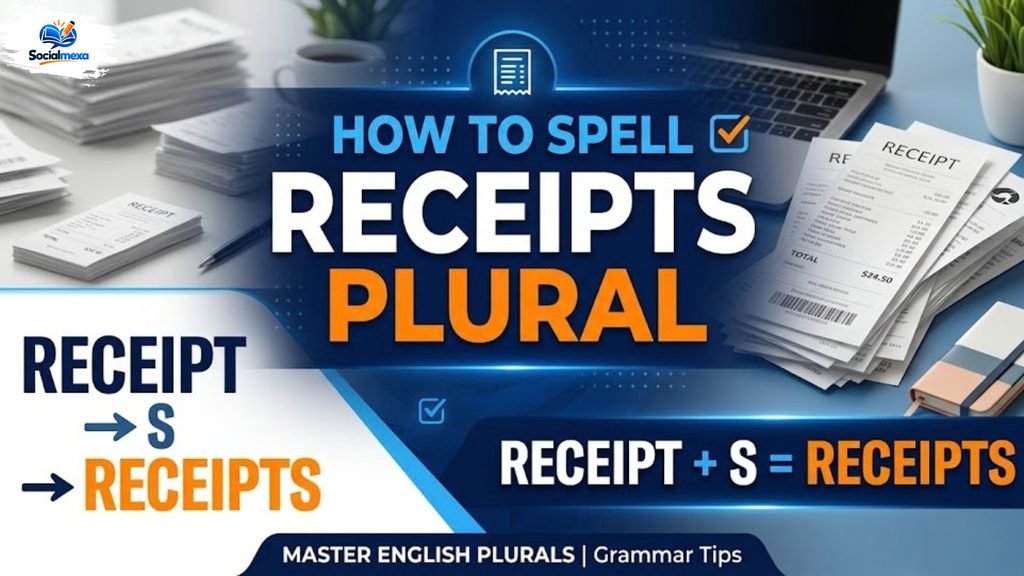
Add a simple s to make receipts. No other changes are needed. You do not swap letters, add an apostrophe, or change the ending.
- One receipt, two receipts
- The receipt is in my wallet. The receipts are in my glove box.
- Wrong: receipt’s (unless you mean something that belongs to the receipt)
The silent P stays in the plural. Writing “reciepts” repeats the original error and adds an extra typo, which is the spelling version of tripping twice on the same stair.
Why Do So Many People Spell It “Reciept”?
Three things push people toward the wrong version.
First, the letters ie appear together in so many common words, like believe, piece, field, and friend. Your brain gets used to seeing I before E and lets it run on autopilot.
Second, the word sounds like “ri-SEET.” The spelling does not reveal the P, so you cannot rely on your ears.
Third, many of us type fast and rarely look at the word again. A mistake that gets repeated enough starts to feel correct.
Understanding the cause helps, but you also need to know what the word actually means.
What Does “Receipt” Actually Mean?
A receipt is written or digital proof that you received something, usually money, goods, or a document. It confirms a transaction took place.
Think of the paper slip from a grocery store, the email after you buy a course, or the page a landlord signs when you hand over rent. Each one answers the same question: “Can you prove that happened?”
Receipts also matter beyond shopping. In the United States, IRS guidance generally asks you to keep documentation for business travel and gift expenses of $75 or more, and tax records are usually worth holding for at least three years. A tiny slip of thermal paper can quietly save you real money.
| Keep Reading These Articles |
| Other Ways to Say “But”: 110+ Powerful Alternatives |
| 95+ Powerful Alternatives to “The Fact That” for Better Writing |
| Thiefs or Thieves? Get the Correct Spelling Fast |
Where Does the Word “Receipt” Come From?
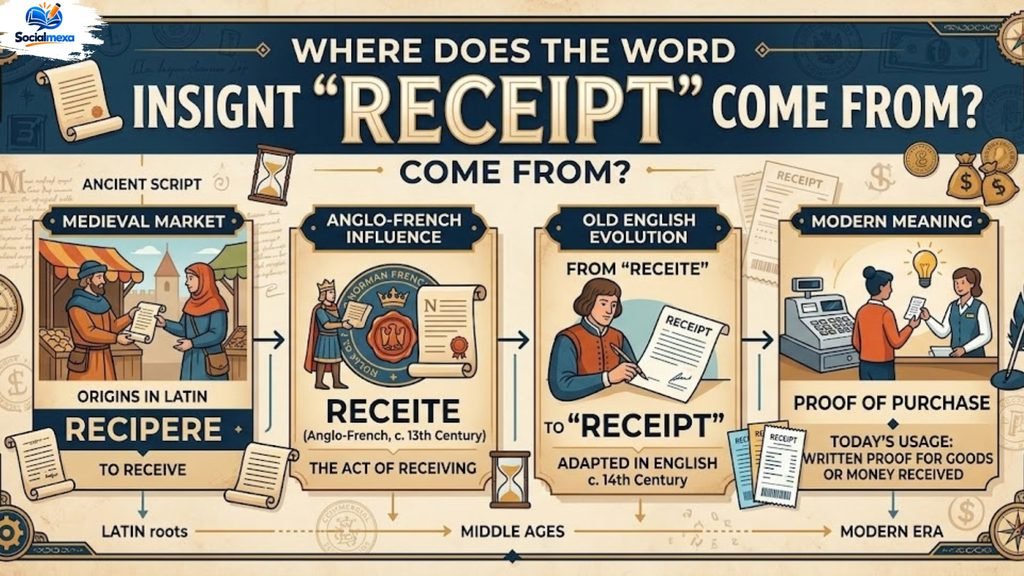
The word starts with the Latin verb recipere, which means “to take back” or “to receive.” From it came the Latin noun recepta, which passed into Old French as receite. English borrowed it around the 1300s and spelled it without a P at first.
Then the 1500s arrived. Scholars wanted English words to look more like their Latin ancestors, so they added letters. That is why the P appeared in receipt, the B appeared in debt, and the B appeared in doubt. The sound never changed. Only the spelling got dressed up.
There is a biblical connection too. In the King James Bible, Matthew 9:9 describes Matthew “sitting at the receipt of custom.” In that old usage, “receipt” meant the place where taxes were collected. The idea of taking in money is baked into the word’s DNA.
For several centuries, “receipt” also meant what we now call a recipe. Older cookbooks often list “receipts” for pies and puddings. So the word has been working overtime for a long time.
Receipt or Reciept Meaning
Here is the short and funny part: reciept has no meaning. It is not a rare variant, a British version, or an old spelling. It is simply an error.
The meaning belongs entirely to receipt. It can work in three ways:
- As a noun: “Keep the receipt.”
- As a verb, though less often: “Please receipt the invoice.”
- As an old word for recipe: “My grandmother’s receipt for apple cake.”
Now that the meaning is settled, let us fix how it sounds.
Receipt Pronunciation
Say it like this: ri-SEET. The IPA is /rɪˈsiːt/. The stress falls on the second syllable, and the P is silent.
Many learners try to pronounce the P because the word has it. Please resist. Saying “ri-SEEPT” will make you sound like a spelling bee contestant who knows the answer a little too well.
Receipt or Received
These two words look like cousins because they are. Received is the past tense of the verb receive. Receipt is the noun that proves you did the receiving.
Compare them in one sentence: “I received the package, so please send me a receipt.”
Both use the same pattern: C followed by E, then I. The difference is that “received” ends in a D and never carries a P, while “receipt” keeps its silent P. Mixing them up leads to mistakes like “recieved,” which is its own common typo.
If this kind of spelling puzzle keeps your brain awake at night, you are in good company. Other confusing pairs worth a look include recipe vs receipt, separate vs seperate, definitely vs definately, and accommodate vs accomodate. Each one has a simple trick behind it, just like the one you are learning now.
Receipt vs Reciept: Quick Comparison Table
| Feature | Receipt | Reciept |
|---|---|---|
| Correct spelling | Yes | No |
| Found in dictionaries | Yes | No |
| Silent letter | P | None (wrong spelling) |
| Follows “I before E, except after C” | Yes | No |
| Plural form | Receipts | Reciepts (also wrong) |
| Accepted in US and UK English | Yes | No |
Use this table as a quick check whenever your confidence wobbles.
How to Pronounce “Receipt” Correctly
Try this simple three step method.
- Say “ri” as in “rip” but softer.
- Say “seet” like the word “seat.”
- Blend them together: ri-seet.
Stress the second part, and keep your lips closed at the end instead of popping a P sound. If you are teaching someone else, ask them to say “receive” first, then change the ending. The sound of “ceive” and “ceipt” starts the same way, which helps the mouth remember.
Receipt in a Sentence: Real-Life Examples
Seeing a word in action makes the spelling stick. Here are practical examples:
- “Can I get a receipt for this coffee?”
- “She kept every receipt from the trip to claim her expenses.”
- “The store will not accept a return without a receipt.”
- “Please send me a digital receipt by email.”
- “Your receipts are stored in the app under Purchases.”
Notice how natural they sound when written correctly. Nobody ever says, “Could I have my reciept, please?” out loud, because the spoken word does not hint at the error. The mistake only shows up on paper.
Receipt of Payment
Receipt of payment is a document that confirms someone paid you or that you paid someone. It protects both sides if a disagreement comes up later.
A solid payment receipt includes:
- The date of payment
- The amount paid
- The name of the payer and the person or business receiving it
- The payment method, such as cash, card, or bank transfer
- A reference or invoice number
- A signature or confirmation, when needed
This matters in real life. Landlords, freelancers, and small shops all rely on a clear receipt to avoid “I already paid you” arguments.
Common Mistakes People Make With “Receipt”
Beyond the famous “reciept,” several small slips show up again and again.
- Reciept: the classic swap of E and I
- Receit or receet: dropping the P entirely
- Recipt: forgetting the second E
- Reciept’s or receipt’s: using an apostrophe where a plain S works
- Recieve or recieved: carrying the same E and I flip into the verb
- Receipt/recipe confusion: using one word when you mean the other
A good habit is to scan for these patterns during your final read. Most errors hide in the middle of the word, where your eyes tend to skip.
Receipt or Reciept Example
Let us put both spellings side by side inside a short, real message.
Wrong: “Hi, I lost the reciept for my laptop. Can you resend the reciepts from March?”
Right: “Hi, I lost the receipt for my laptop. Can you resend the receipts from March?”
See how the correct version looks calm and professional? The wrong one makes a reader pause, and that pause can cost you credibility, especially in emails to clients, banks, or HR.
The “I Before E” Rule and Why It Fails Here

Here is a twist: the rule does not actually fail in this word. It works perfectly. The full rule says “I before E, except after C.” Since receipt has a C right before the vowel pair, the E comes first. That is exactly what the rule predicts.
So why does it feel like it fails? Because the rule has a long list of exceptions, such as weird, seize, either, protein, and species. After enough exceptions, people stop trusting it and guess instead. When they guess, “ie” feels more familiar, and “reciept” slips out.
The better approach is to treat the after C part as the key. Whenever a C sits right before that vowel pair, switch to ei.
Related Words That Confuse People Too
Receipt has plenty of lookalike cousins. Learning them together saves you from repeating the same mistake in other words.
Words that follow the CEI pattern:
- receive
- deceive
- perceive
- conceive
- ceiling
Words that look similar but behave differently:
- Recipe: pronounced RES-uh-pee, a set of cooking instructions
- Reception: a front desk or a welcome event
- Receptor: a part of the body or device that receives signals
Notice that recipe and receipt both came from the same Latin root. They simply took different roads over the centuries.
Which One Should You Use?
Always use receipt. There is no situation where “reciept” is the better choice, not in school, business, texting, or social media.
If you are writing for an international audience, you can relax. American, British, Canadian, and Australian English all agree on this one. It is one of the rare spelling topics where everyone can shake hands and move on.
How Do You Spell Receipt for Money
When the receipt involves money, the spelling stays exactly the same: receipt. You may see it in phrases like:
- Cash receipt: proof that you paid in cash
- Money receipt: a common phrase in some regions for a payment slip
- Receipt book: a pad of numbered blank receipts
- Official receipt: a formal document used for accounting
A simple template line looks like this: “Received from John Miller the sum of $250 for January rent.” Notice the word received appears in the sentence, while receipt names the document itself.
For security, US law under FACTA limits how much of your card number can print on a customer receipt, usually the last five digits at most. That is why you only see a few numbers, never the whole card.
Simple Tricks to Never Misspell “Receipt” Again

Pick the trick that fits your brain.
- The CEI trick: Remember that C leads to EI. Receipt, receive, and ceiling all share it.
- The silent P picture: Imagine a tiny P sleeping inside the word like a cat in a laundry basket. It does not make noise, but it is definitely there.
- Say it wrong on purpose: Pronounce it “re-SEE-ipt” in your head while typing. The extra sound reminds your fingers of the P.
- Pair it with receive: Type “receive” first, then change the ending.
- Add it to your autocorrect: Set your phone to turn “reciept” into “receipt” automatically.
- Write it five times: Boring, yes, but handwriting builds memory faster than most apps.
Use two of these, and the mistake will fade within a week.
Frequently Asked Questions
What is the meaning of receipt?
A receipt is a document or message that confirms you received money, goods, or information. It acts as proof of a transaction, and in older English it could also mean a recipe.
How do you spell “receipt” in the UK?
The UK spelling is also receipt. British English does not change the word at all. Some people in the UK say “till receipt” or “slip,” but the written spelling stays the same.
How do Americans spell receipts?
Americans spell it receipts for the plural and receipt for the singular. The spelling matches British English exactly, so there is no regional difference to memorize.
Is it a receipt or receipts?
Use receipt for one and receipts for more than one. Example: “I need one receipt for the laptop and three receipts for the trip.”
Final Thoughts
The answer is simple: write receipt, with a silent P and an E before the I. The word comes from Latin, picked up its extra letter during the 1500s, and has served people faithfully ever since, from tax booths in the Bible to your last grocery run.
Keep the CEI pattern in your pocket, say the word out loud once, and watch the red underline disappear for good. Now go find that receipt before your return window closes.

Emily Carter is an English language writer who creates simple guides on grammar, word meanings, spelling, slang, and everyday English. Her goal is to make confusing language topics clear, practical, and easy to understand.
2 thoughts on “Receipt or Reciept? Get the Spelling Right”