

The word “but” does a lot of work. It shows contrast, marks an exception, corrects a statement, and sometimes means “only.” Because it does so many jobs, no single replacement fits every sentence. This guide groups more than 110 alternatives by what they actually do, so you can match the word to your meaning and tone.
Quick answer: The most common replacements for “but” are however, yet, though, still, and even so for contrast, and except, apart from, and other than for exceptions. Use formal words like nevertheless in essays and reports, and lighter ones like though or still in conversation. Always check the meaning first, because these words differ in strength, tone, and punctuation.
What “but” Means and Why Synonyms Are Not Interchangeable
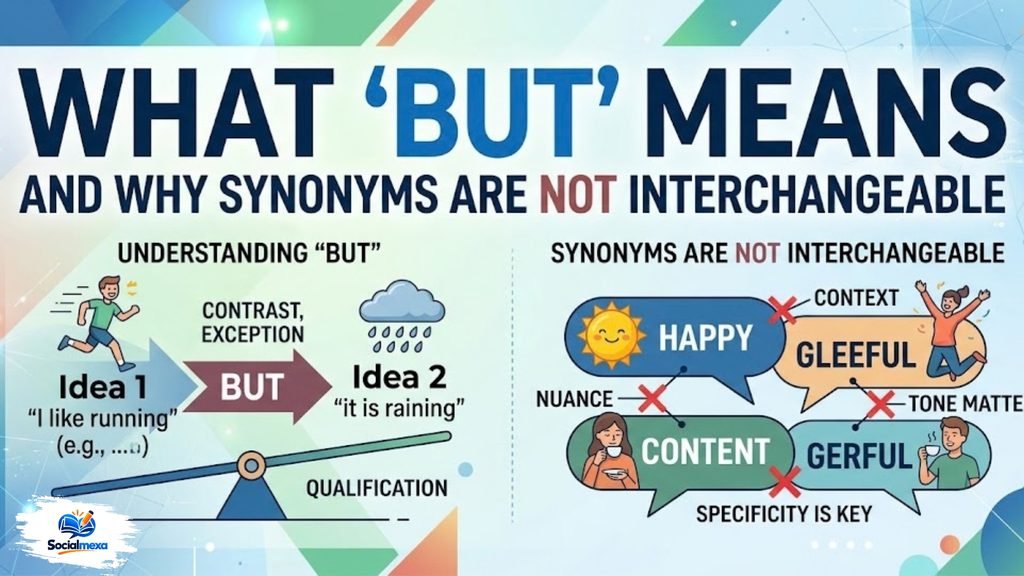
“But” has four main jobs:
- Contrast: “I like tea, but I prefer coffee.”
- Exception: “Everyone but Dana arrived early.” Here “but” works like except.
- Correction: “It wasn’t rude, but honest.” It replaces a wrong idea with a better one.
- Only: “He was but a child.” This use is rare and sounds old-fashioned today.
Most synonyms cover only one or two of these jobs. However handles contrast but not exceptions. Except handles exceptions but not contrasts. Swapping them blindly leads to sentences that sound odd or mean something different.
| More Articles to Explore |
| Many or Meny? Discover the Correct Spelling & Meaning |
| Lilies or Lillies? Discover the Correct Spelling |
| Emphasise or Emphasize? Get the Spelling Right |
Comparison Table: Common Synonyms for “But”
| Synonym | Meaning Nuance | Tone | Example Sentence |
| however | Contrast with the previous point | Formal to neutral | The report is thorough. However, it ignores last year’s data. |
| nevertheless | Contrast despite an obstacle | Formal | The road was closed. Nevertheless, most guests arrived on time. |
| nonetheless | Same idea as nevertheless, slightly lighter | Formal | The plan has risks. We should try it nonetheless. |
| notwithstanding | Despite, often in official writing | Very formal | Notwithstanding the delay, the launch went ahead. |
| even so | Contrast despite what was just said | Neutral | The hotel was old. Even so, we loved it. |
| yet | Surprising contrast within a sentence | Neutral to literary | She trained for months, yet she still doubted herself. |
| still | Contrast, despite that | Neutral | It rained all day. Still, the parade went on. |
| though | Light contrast, works at the end of a sentence | Casual to neutral | The food was great. The service was slow, though. |
| although | Opens a clause with contrast | Neutral | Although the tickets were pricey, we bought two. |
| whereas | Compares two facts side by side | Formal | Maya prefers mornings, whereas Leo works best at night. |
| while | Side by side contrast, also used for timing | Neutral | While some voted early, others waited until the last day. |
| on the other hand | Presents an opposing option | Neutral | Remote work saves time. On the other hand, it can feel isolating. |
| by contrast | Highlights a sharp difference | Formal | The north is dry. By contrast, the south gets heavy rain. |
| conversely | Shows the reverse relationship | Formal | Higher prices can lower demand. Conversely, discounts can raise it. |
| on the contrary | Denies the previous claim | Formal | He didn’t lose interest. On the contrary, he asked for more. |
| that said | Admits a point, then pivots | Neutral | The idea is bold. That said, it needs a budget. |
| admittedly | Concedes a weakness first | Neutral to formal | Admittedly, the first draft was rough. The final version is solid. |
| granted | Accepts a point, then argues | Neutral | Granted, the app is simple. It does exactly what I need. |
| unfortunately | Softens disappointing news | Polite | We would love to join. Unfortunately, we already have plans. |
| the catch is | Reveals a drawback | Casual | The deal is cheap. The catch is the long contract. |
| except | Removes one item from a group | Neutral | We ate everything except the olives. |
| apart from | Sets one thing aside | Neutral | Apart from a sore knee, he felt fine. |
| other than | Excludes, often after negatives | Neutral | No one other than Priya knew the password. |
| aside from | Excludes, or means “in addition to” | Neutral, common in US English | Aside from the price, it’s a great car. |
| besides | Excludes in negative sentences | Casual | Nobody besides Tom called. |
| barring | Excludes, “unless this happens” | Formal | Barring storms, the flight leaves at noon. |
| rather | Corrects a wrong idea | Neutral to formal | It wasn’t a failure. Rather, it was a lesson. |
| instead | Offers a replacement | Neutral | Skip the long email. Send a short note instead. |
| only | Adds a limit, informal | Casual | I’d go, only I have no ride. |
| merely | Stresses that something is small | Formal | He was merely a student when he wrote it. |
Formal and Neutral Alternatives for Contrast
These words usually begin a new sentence or follow a semicolon. They suit essays, reports, and professional writing.
Strong pivots: however, nevertheless, nonetheless, notwithstanding, even so, all the same, be that as it may, that said, having said that, that being said, in spite of that, despite that, in spite of this, despite this, regardless, for all that, just the same.
Concession openers: admittedly, granted, to be fair, in fairness. These admit a point before you push back, which makes you sound balanced.
Inside a phrase: albeit. Example: “It was a small albeit important change.”
Joining two clauses: although, though, even though, whereas, while, whilst, yet, and yet, still. “Whilst” is mostly British, so most US writers will prefer “while.”
Comparing two things: on the other hand, by contrast, in contrast to, by comparison, in comparison, conversely, on the contrary, unlike, at the same time, on the flip side, then again, alternatively, even then.
However
“However” is the most popular formal swap. It must be punctuated correctly. Use a period before it or a semicolon, then a comma after it: “We planned a picnic; however, the weather changed.” A comma alone before “however” creates a comma splice.
Yet
“Yet” signals a surprising contrast and works inside one sentence. “The apartment is tiny, yet it feels spacious.” It is stronger than “but” because it suggests the second idea is unexpected.
Though and Although
Both introduce a contrast. “Although” usually opens a clause. “Though” can do the same, and it can also close a sentence in a relaxed way: “It’s a good phone. Pricey, though.” “Even though” adds extra force.
Nevertheless and Nonetheless
These two mean nearly the same thing and carry a formal tone. Use them when something stands true despite a clear obstacle. Do not stack them in one paragraph, because they begin to sound heavy.
Casual and Conversational Alternatives
In everyday speech, short and light words feel more natural than formal ones.
- Light pivots: still, though, even so, then again, mind you, even then
- Problem pointers: the catch is, the problem is, the trouble is, the downside is, the only drawback is, the challenge is, the thing is
- Informal connectors: only, except that
Example: “I’d love to come. The thing is, I have an early shift.”
Polite and Softening Alternatives for Work and Email
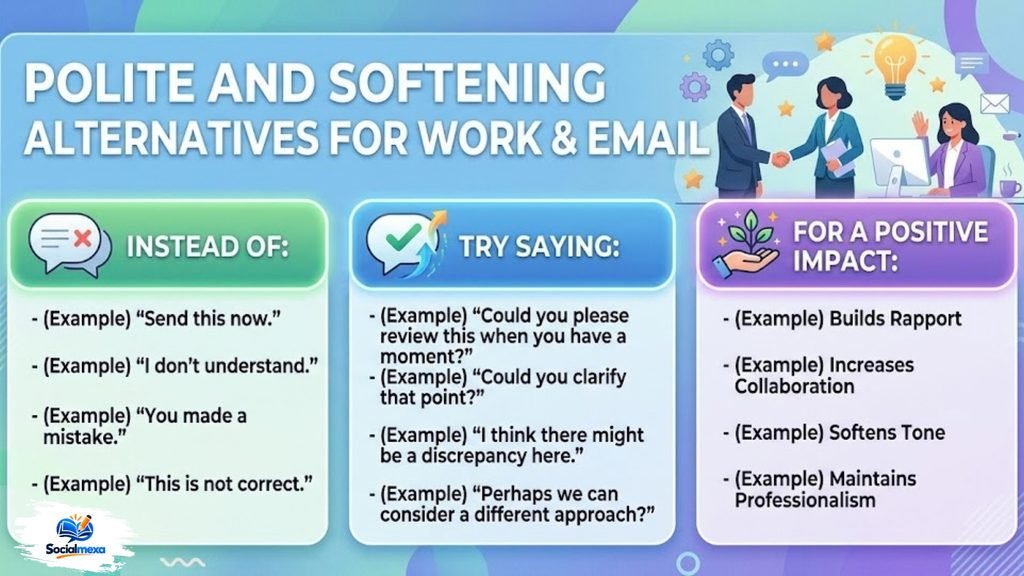
When you disagree or share bad news, the word you choose affects how the message lands.
- Soft openers: unfortunately, regrettably, one concern is, the only issue is
- Gentle bridges: that is not to say, even with that, at the same time
- Using “and”: Sometimes the kindest option is plain “and.” Compare “I see your point, but we need more time” with “I see your point, and we need more time.” The second feels less like a rejection.
Alternatives That Mean “Except”
When “but” marks an exception, use words from this group. They are not suitable for contrast.
Common choices: except, except for, apart from, aside from, other than, besides.
Formal or literary: barring, save, save for, excepting, bar, with the exception of, outside of.
Counting and listing style: excluding, not counting, not including, leaving out, omitting, minus, short of.
Phrases that set something aside: aside from that, save that, setting aside, putting aside, leaving aside, that aside, with one exception.
Example: “All the interns but Jordan finished on time” becomes “All the interns except Jordan finished on time.”
Except, Apart From, and Other Than
These three are safe in nearly every context. “Except” is the plainest. “Apart from” and “other than” sound slightly smoother in longer sentences.
Alternatives for Correction
Use these when you replace a wrong idea with the right one, as in “not red but orange.”
rather, instead, instead of, or rather, as opposed to, rather than, in fact, actually, more precisely.
Example: “The meeting wasn’t canceled. Rather, it moved to Friday.”
Alternatives That Mean “Only”
For the old-fashioned “He was but a child,” use: merely, just, simply, no more than, nothing more than, solely, nothing except.
Example: “She was nothing more than a trainee when she joined.”
Ways to Rewrite a Sentence Without “But”
Sometimes a different sentence structure works better than a one-word swap.
- Start with a contrast word: “Although the plan was risky, we tried it.”
- Use a noun phrase: “Despite the risk, we tried it.” Related options: in spite of, despite the fact that, in spite of the fact that, regardless of, even with, no matter.
- Use a conditional shape: “Even if the plan fails, we will learn something.”
- Split into two sentences and add a pivot: “The plan was risky. Even so, we tried it.”
- Use “except for the fact that” when you want to name the single flaw: “The trip was perfect, except for the fact that we missed the train.”
- Use “that notwithstanding” in formal writing: “That notwithstanding, the team met its goal.”
How to Use These Words in Different Settings
- Email: Choose “however,” “that said,” or “unfortunately” to keep a professional tone. Avoid heavy words like “notwithstanding.”
- Resume: Resume bullets rarely need contrast. Use “while” to show two results at once: “Cut delivery times while keeping error rates low.”
- Essay: Use “however,” “nevertheless,” “whereas,” and “by contrast.” Concession words such as “admittedly” and “granted” help you sound fair before you argue your point.
- Conversation: Stick with “though,” “still,” “the thing is,” and “then again.”
- Social media: Short phrases work best. “Still,” “though,” and “the catch is” fit captions and replies. Keep it casual.
- Storytelling: “Yet” and “and yet” add tension. “Even so” and “all the same” help a narrator describe a stubborn character: “It was freezing. All the same, she stayed outside.”
Antonyms of “But”
“But” has no single true opposite, because it signals a turn. The closest opposites are words that continue the same direction, add information, or agree:
and, also, plus, as well as, moreover, furthermore, in addition, additionally, likewise, similarly, what’s more.
Words like “therefore,” “so,” and “thus” are different again. They show a result rather than a contrast.
Related Words and Phrases
“But” belongs to a small group of connecting words. The classic list of coordinating conjunctions is for, and, nor, but, or, yet, and so. Writers also use transition words and concession words to guide readers from one idea to the next.
Several common phrases contain “but” and cannot be swapped with a simple synonym:
- all but: almost. “The room was all but empty.”
- anything but: not at all. “The test was anything but easy.”
- nothing but: only. “He ate nothing but toast.”
- cannot help but: cannot stop yourself from. “I can’t help but smile.”
- but for: were it not for. “But for the rain, it would have been perfect.”
- last but not least: final item, equally important.
- no ifs, ands, or buts: no excuses.
When Not to Use These Synonyms
- however: Do not join two full sentences with only a comma before it.
- nevertheless, nonetheless, notwithstanding: These sound stiff in texts, chats, and friendly emails.
- on the contrary: Use it only when you are denying a claim, not for mild contrast.
- whereas: It compares two facts. It does not work when one fact overcomes an obstacle.
- while: It can also mean “at the same time,” so avoid it when that reading could confuse the reader.
- besides: It can mean “other than” or “in addition to.” If both readings are possible, choose “except” or “apart from.”
- barring: Use it only for “unless this happens” situations, such as “barring delays.”
- yet: Do not use it for exceptions. “Everyone yet Sam” does not work.
- unfortunately, regrettably: Use them only when there is genuinely bad news.
- merely, only, just: Be careful when describing people. “She is merely an assistant” can sound insulting.
- anyway, anyhow: These often get listed as synonyms, but they usually return to a topic or change it. They do not signal real contrast.
FAQs
Can I start a sentence with “but”?
Yes. It is acceptable in most modern writing, especially in blogs, emails, and fiction. In very formal academic or legal writing, many writers prefer “however” or “nevertheless.”
Is “however” always better than “but”?
No. “However” sounds more formal, but “but” is shorter and often clearer. Overusing “however” can make writing feel stiff.
Does “but” need a comma before it?
Use a comma when “but” joins two complete clauses: “I wanted to go, but I was tired.” You usually do not need one when “but” joins short phrases: “It was cheap but good.”
What is the most formal alternative to “but”?
“Notwithstanding” and “nevertheless” are among the most formal. “Notwithstanding” is especially common in legal and official writing.
What is a polite way to say “but” in an email?
Try “that said,” “at the same time,” or “unfortunately.” You can also replace “but” with “and” when you want to sound less like you are rejecting an idea.
What is the difference between “though” and “although”?
Both show contrast. “Although” usually starts a clause. “Though” can start a clause too, and it can also end a sentence in casual speech or writing.
What can I use instead of “but” to mean “except”?
Use “except,” “apart from,” “other than,” or “aside from.” These are the safest choices for everyday writing.
Conclusion
The best replacement for “but” depends on the job the word is doing. Use contrast words like “however,” “yet,” and “even so” when ideas push against each other. Use exception words like “except” and “apart from” when you remove something from a group. Use “rather” or “instead” when you correct an idea.
Do not chase variety for its own sake. “But” is a perfectly good word, and it is often the clearest choice. Swap it when you want a different tone, a stronger shift, or a smoother rhythm, and keep it when it already does the job well.

Emily Carter is an English language writer who creates simple guides on grammar, word meanings, spelling, slang, and everyday English. Her goal is to make confusing language topics clear, practical, and easy to understand.
1 thought on “Other Ways to Say “But”: 110+ Powerful Alternatives”