

“Sincerely” is the safe closing for formal letters, but it can feel stiff in a quick email or too cold in a warm message. The right alternative depends on who you are writing to and how well you know them.
This guide groups the best options by tone, explains how they differ, and shows where each one fits. It also covers the other meaning of “sincerely,” the adverb, so you can find a fresh word for that too.
Quick answer: The best alternatives to “sincerely” are “best regards,” “kind regards,” “respectfully,” “warm regards,” and “best.” Use “best regards” or “kind regards” for most work emails, “respectfully” for very formal or hierarchical messages, and “warmly” or “all the best” when you know the reader well.
| Check Out These Articles |
| Speach or Speech? Discover the Correct Spelling |
| Lieing or Lying? Discover the Correct Spelling Now |
| Emphasize or Emphasise: Which Spelling Is Correct UK vs USA |
What “Sincerely” Means
“Sincerely” is an adverb that means in a sincere way, without pretending. When people write “I sincerely hope you feel better,” they mean the wish is honest.
Most searches for this word are about something else, though. In letters and emails, “Sincerely” is a complimentary close, the short phrase placed before your name. In that role it signals respect and good faith, and it has become the default ending for formal and professional writing in the United States.
So there are two jobs to cover:
- Replacing “sincerely” as a sign-off.
- Replacing “sincerely” as an adverb inside a sentence.
Other Ways to Say “Sincerely” as a Sign-Off
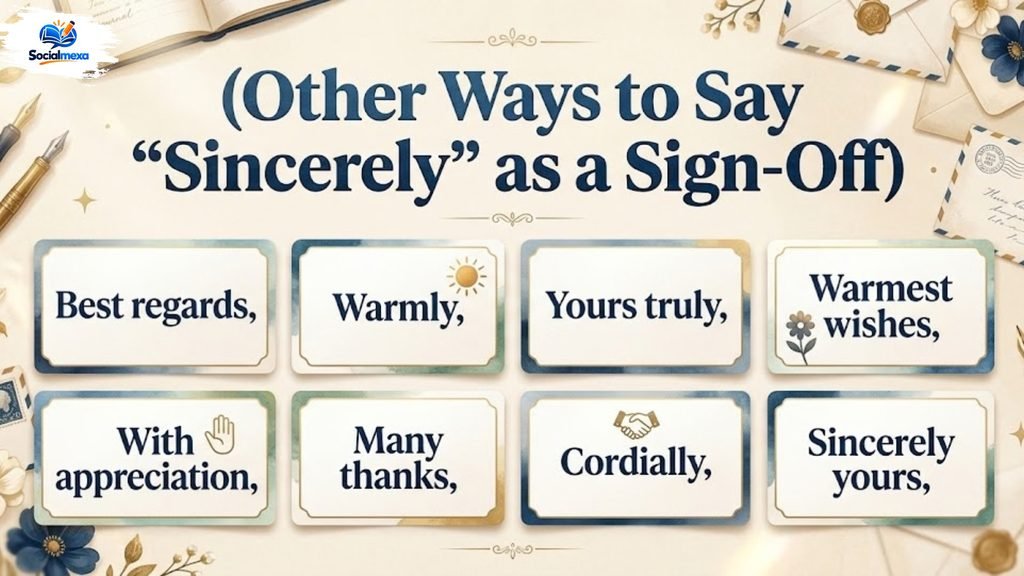
Sign-offs sit on a scale from formal to casual. Pick the one that matches your relationship with the reader, not the one that sounds the fanciest.
Formal and Traditional
These suit cover letters, complaints, legal or academic messages, and first contact with someone senior.
Respectfully. This one adds deference. It fits letters to officials, judges, professors, or anyone whose position you want to acknowledge. It can sound distant in ordinary office email.
Yours truly. A classic, slightly old-fashioned close. It works for formal letters, but many readers now find it a little dated.
Cordially. Polite and friendly without being personal. It suits invitations and business letters where you want courtesy without stiffness.
Respectfully yours. A longer, more ceremonial version of “respectfully.” Save it for very formal letters.
Professional but Friendly
These are the workhorses of modern office email.
Best regards. Neutral, polite, and safe. It works for clients, colleagues, and new contacts, and rarely feels wrong.
Kind regards. Slightly softer than “best regards.” It reads as considerate, which helps when you are asking for a favor or following up.
Regards. Short and businesslike. It can feel brisk, so it works better in routine exchanges than in a first message.
Best. Quick and relaxed. It is common between coworkers who already exchange messages often.
Thank you. A good close when you are making a request or answering someone’s help. It carries real meaning, so use it when you actually mean thanks.
Warm and Personal
These fit people you know, or situations where kindness matters more than formality.
Warm regards. A step warmer than “kind regards.” It suits mentors, long-term clients, and friendly business contacts.
Warmly. Personal and gentle. It works for notes of support, congratulations, or thanks.
All the best. Pleasant and open-ended, often used when wishing someone well in the future, such as after a job change.
With appreciation. Direct and specific. It makes sense after someone has helped you.
Take care. Casual and caring. It works with friends and with colleagues you know well, especially after a personal topic.
Casual
Cheers. Light and friendly. It is more common in British and Australian writing, and some US readers may find it too informal for business.
Talk soon. Fits ongoing conversations where another exchange is already expected.
Comparison Table: Sincerely and Its Alternatives
| Synonym | Meaning Nuance | Tone | Example Sentence |
| Sincerely | Honest, respectful close | Formal, neutral | Sincerely, Maria Lopez |
| Best regards | Polite good wishes | Professional, neutral | Best regards, Daniel Reed |
| Kind regards | Courteous and considerate | Professional, soft | Kind regards, Priya Shah |
| Respectfully | Shows deference to the reader | Very formal | Respectfully, Thomas Greene |
| Yours truly | Traditional formal close | Formal, dated | Yours truly, Ellen Parker |
| Cordially | Polite and courteous | Formal, friendly | Cordially, James Whitaker |
| Warm regards | Friendly good wishes | Warm, professional | Warm regards, Nina Brooks |
| Warmly | Personal and kind | Warm, personal | Warmly, Sam |
| All the best | Good wishes for the future | Friendly | All the best, Leah |
| With appreciation | Thanks for a specific help | Warm, sincere | With appreciation, Carlos Diaz |
| Best | Short, easy sign-off | Casual professional | Best, Aisha |
| Regards | Brief and businesslike | Neutral, brisk | Regards, Mark Owens |
| Thank you | Gratitude as a close | Polite, direct | Thank you, Rachel Kim |
| Cheers | Light, friendly farewell | Casual | Cheers, Tom |
How These Sign-Offs Differ
Many of these words look interchangeable, but small differences matter.
“Best regards” and “kind regards” are close, yet “kind regards” feels more personal. If you are replying to a stranger or sending a routine update, “best regards” is the safer pick. If you are writing to someone who has been patient with you, “kind regards” fits better.
“Respectfully” and “sincerely” are not the same. “Sincerely” shows honest intent, while “respectfully” shows you recognize the other person’s rank or authority. Using “respectfully” with a friendly peer can feel oddly distant.
“Regards” is the shortest of the group and can come across as cool, especially after a long message or a disagreement. Adding “best” or “kind” usually softens it.
“Thank you” works as a sign-off only when it makes sense in context. If you have not asked for anything or received help, it can feel out of place.
Which Sign-Off to Use in Each Situation
For most work emails, “best regards,” “kind regards,” or “best” is enough. Use “thank you” when you are asking for something. Reserve “sincerely” or “respectfully” for formal messages, such as a complaint, a formal request, or a message to a senior official.
Resume and Cover Letters
A cover letter is a formal letter, so “sincerely” is still a strong choice. “Best regards” and “respectfully” are also acceptable. Keep the close plain and professional, and avoid casual choices like “cheers.”
Formal Letters
Printed or mailed letters follow tradition more closely. “Sincerely,” “yours truly,” “respectfully,” and “cordially” all fit. Put a comma after the close, then leave space for your signature, then type your name.
Social Media and Messaging
Sign-offs are optional here. If you want one, “thanks,” “talk soon,” or “take care” sounds natural. “Sincerely” can sound jokey or overly stiff in a direct message.
British Usage
In British English, “yours sincerely” is traditionally used when you open with a person’s name, such as “Dear Ms Taylor.” “Yours faithfully” is the traditional pair for “Dear Sir or Madam.” Many modern emails skip these rules, but you may still see them in formal letters.
Other Ways to Say “Sincerely” as an Adverb
When “sincerely” appears inside a sentence, you can swap it for a word that fits the same feeling. The choice depends on how strong or formal you want to sound.
Genuinely. Natural and widely used. “I genuinely appreciate your help.”
Truly. Warm and slightly emphatic. “I truly hope this works out.”
Honestly. Direct and conversational. “I honestly think it’s a good plan.”
Earnestly. Serious and eager. “She earnestly asked for feedback.”
Wholeheartedly. Strong and full of commitment. “We wholeheartedly support the proposal.”
Heartily. Enthusiastic and warm, often used with thanks. “I heartily recommend this book.”
Deeply. Emphasizes depth of feeling. “I deeply regret the delay.”
Really. Casual and common in speech. “I really mean it.”
Note that “sincerely” is milder than some of these. “Wholeheartedly” and “deeply” add intensity, so do not swap them in if you want a calm tone.
Antonyms of “Sincerely”
As an adverb, the opposites of “sincerely” are:
- Insincerely
- Falsely
- Dishonestly
- Disingenuously
- Hypocritically
- Deceitfully
As a sign-off, “sincerely” has no true opposite. The closest contrasts are ending with no close at all, which can feel abrupt, or using a cold, clipped one such as a bare “Regards.”
Related Words and Phrases
These terms often appear near “sincerely” in writing about letters and tone:
- Complimentary close
- Sign-off
- Salutation
- Closing line
- Sincerity
- Heartfelt
- In good faith
- From the bottom of my heart
- With all sincerity
When Not to Use Each Alternative
No sign-off works everywhere. Here is where each common choice can backfire.
- Respectfully: Avoid it with friendly peers or in casual chats, where it can sound cold or even sarcastic.
- Yours truly: Avoid it in modern, informal emails, where it can feel old-fashioned. It can also be read as a playful way of referring to yourself.
- Cordially: Avoid it when delivering bad news or showing deep emotion, because it can feel too polished.
- Warm regards and warmly: Avoid them in a first message to a stranger, a legal notice, or a tense exchange, where warmth may seem forced.
- Regards: Avoid it after a disagreement or an apology, since the short form can read as curt.
- Best: Avoid it in a highly formal letter, where it looks too casual.
- Thank you: Avoid it when nothing has been requested or done, so the thanks does not seem automatic.
- Cheers: Avoid it in formal US business writing, or with readers who may not use it themselves.
- Take care and all the best: Avoid them in strict business or legal messages, where they can seem too personal.
Frequently Asked Questions
Is “sincerely” still appropriate in an email?
Yes. It remains a clear, polite choice for formal emails, job applications, and official requests. In everyday office messages it can feel a bit formal, so “best regards” or “best” may sound more natural.
What is a good professional alternative to “sincerely”?
“Best regards” and “kind regards” are the most common and safest picks. “Respectfully” suits very formal contexts, while “warm regards” works when you have a friendly working relationship.
Is “sincerely” the same as “yours sincerely”?
They have the same meaning, but the usage conventions differ. “Sincerely” is the standard form in American English. “Yours sincerely” is the traditional British form, often paired with a greeting that uses the reader’s name.
Can I end a cover letter with “best regards”?
Yes. “Best regards” is widely accepted in cover letters. “Sincerely” and “respectfully” are also good choices if you want a more formal feel.
Is it rude to end an email without a sign-off?
It is not rude in a quick back-and-forth, where closing lines are often dropped. In a first message, a formal request, or a message to someone senior, a short close and your name is better.
What is a warm way to end a message to a friend or colleague?
“Warmly,” “all the best,” “take care,” and “talk soon” all work. Match the one you choose to how close you are and what the message is about.
Should I use a comma after “sincerely”?
Yes. In standard usage, put a comma after the close, then start a new line with your name.
Conclusion
“Sincerely” is a reliable, respectful close, but it is only one tool. For everyday professional email, “best regards” or “kind regards” usually fits better. For formal or hierarchical messages, “respectfully” or “cordially” shows the right level of care, and for people you know, “warmly” or “all the best” sounds more human.
When you choose a sign-off, think about three things: who is reading, how well you know them, and what the message needs to feel like. A close that matches the moment will always sound more genuine than one chosen only because it looks polished. And if you need a replacement for the adverb inside a sentence, words like “genuinely,” “truly,” and “wholeheartedly” give you different levels of warmth and strength.

Emily Carter is an English language writer who creates simple guides on grammar, word meanings, spelling, slang, and everyday English. Her goal is to make confusing language topics clear, practical, and easy to understand.